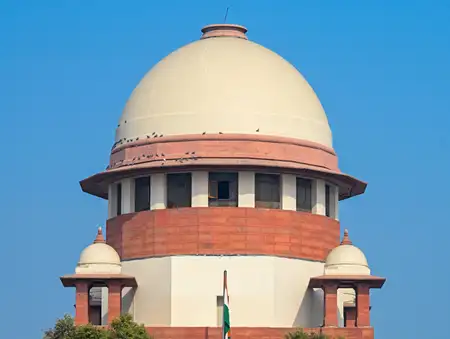
New Delhi, May 15 (IANS). The Supreme Court on Friday ordered the premature release of Rohit Chaturvedi, one of those convicted in the murder case of poet Madhumita Shukla. The court said that the decision of the Union Home Ministry to reject his plea for remission of sentence was arbitrary, without any explanation and unsustainable on the basis of law and merit.
A bench of Justices BV Nagarathna and Ujjwal Bhuyan set aside a letter dated July 9, 2025, issued by the Ministry of Home Affairs (MHA) refusing to agree with the Uttarakhand government’s recommendation to release Chaturvedi after spending more than 22 years in jail.
The Supreme Court said that it is very clear that this letter is prima facie without any solid basis, because no reason has been given for the decision taken by the competent authority. The Court further said that recording the reasons is not a mere formality. It is a safeguard against arbitrariness and ensures transparency, fairness and accountability in the decision-making process.
The Supreme Court said that in the MHA order it was only stated that it did not agree with the proposal of the Uttarakhand government, but the grounds for disagreement were not mentioned. A bench headed by Justice Nagarathna said that there has been no discussion on the conduct of the petitioner, the exemption policy in force or any specific adverse material against the petitioner.
The judgment said that the executive’s discretion in matters of exemption is not unlimited and should be exercised only on relevant, rational and non-discriminatory grounds.
Rejecting the Central Government’s argument that remission of sentence can be denied due to the heinous nature of the crime. The Supreme Court said, “In a constitutional system governed by the rule of law, remission of sentence cannot be denied merely on the ground of heinousness of the offence. The seriousness and heinousness of the offense ceases to exist at the stage of sentencing and the judicial determination of sentence necessarily takes these factors into account.”
The Supreme Court emphasized that remission of sentence is linked to the reformative principle of punishment. The Court remarked that justice does not permit that a person be kept in jail forever under the shadow of his worst act.
Referring to the conduct of the petitioner in jail, the Court observed that the custody certificate specifically recorded that his conduct during his stay in jail had been good.
A bench headed by Justice Nagarathna also took cognizance of the fact that co-convict and former Uttar Pradesh minister Amarmani Tripathi was given premature release by the Uttar Pradesh government in August 2023 itself after serving almost 17 years of the actual jail sentence.
The top court said that when a co-accused, connected with the same incident, involved in the same crime, has been given the benefit of premature release after spending less time in jail, there must necessarily be some concrete, logical and clearly identifiable extenuating circumstance to deny the same benefit to the petitioner. In the absence of such reasons, differential treatment between co-accused would be considered contrary to the constitutional requirement of fairness and non-arbitrariness.
The top court said that sending the matter back to the Ministry of Home Affairs (MHA) for reconsideration would be of no use, as the central government had already presented its stand before the top court.
Since Chaturvedi was already on interim bail under a previous order passed in May 2025, the Supreme Court directed that he would not be required to surrender and the authorities would treat him as prematurely released/acquitted.
Former Uttar Pradesh minister Amarmani Tripathi, his wife Madhumani Tripathi, nephew Rohit Chaturvedi and shooter Santosh Rai were convicted by a Dehradun court in the 2007 murder case of poet Madhumita Shukla.
–IANS
PSK