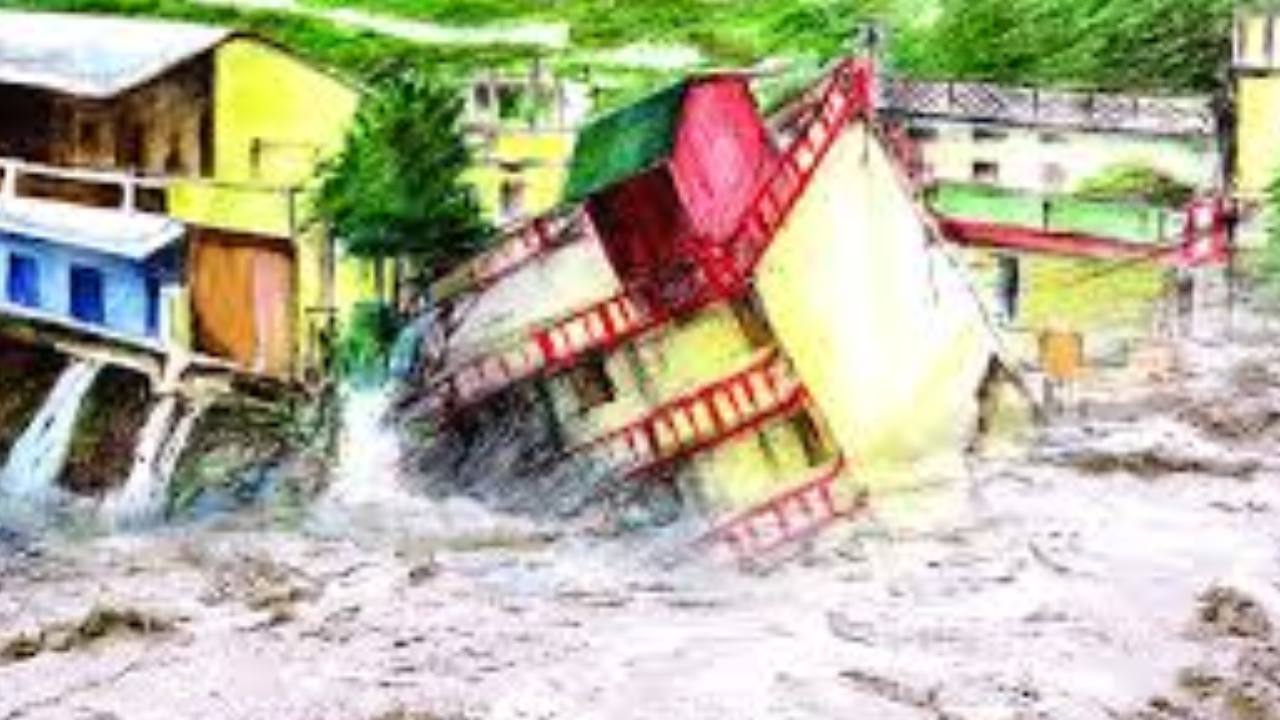
The recent disasters in Uttarakhand, Himachal Pradesh and Jammu and Kashmir have posed a deep threat to the sensitivity of the Himalayas and the survival of its rivers. Ganga, Yamuna and their tributaries flowing through the Central Himalayas are witnessing these devastating natural events. The incidents of floods, landslides and cloud bursts have not only caused huge loss to life and property but have also raised serious alarm bells for the health of the Himalayas and the associated plains.
the entire valley is deserted
From 2010 to 2025, disasters have been occurring one after another in the Himalayan states. The Kedarnath tragedy (2013) saw the country witness devastation on such a massive scale for the first time, where thousands of people went missing in a matter of hours and the entire valley was left desolate. After this, the incidents of cloud burst in Rishiganga (2021), Joshimath (2023), Balganga (2024) and now in 2025 in Uttarkashi, Kullu, Kishtwar and Kathua have proved that the Himalayas are now continuously warning.
sinister sign
This warning is not limited to the mountains only; This is for the whole of India, where the water of these rivers is the basis of life. Talking about this year itself, more than 67 people died, more than 300 people were injured and more than 200 people went missing due to cloud burst in Chositti village of Kishtwar district of Jammu and Kashmir. Many houses were washed away due to cloudburst in the upper reaches of Kheerganga in Dharali village of Uttarkashi district of Uttarakhand. Roads and bridges were damaged in Sainj Valley of Kullu district of Himachal Pradesh, completely cutting off villages. Cloud burst incidents also caused devastation in Kathua district of Jammu and Kashmir. The occurrence of so many disasters in a single year is a frightening sign in itself.
shock to lifestyle
These disasters have not only caused material loss but have also dealt a deep blow to the morale of the people, their cultural heritage, religious pilgrimages and traditional lifestyle. The Himalayas, which were once considered a symbol of spirituality, peace and biodiversity, are today becoming disaster-prone areas.
increased risk
From a scientific point of view, the Himalayas are the youngest mountain range in the world, which is still geologically active. This region, formed by the collision of the Indo-Eurasian tectonic plates, keeps shifting and changing. For this reason, there is always a risk of earthquake and landslides here. When anthropogenic pressure on this unstable geological region increases—such as blasting for tunnels, heavy construction work, and uncontrolled urbanization—this risk increases manifold.
How does a cloud burst?
Climate change has also increased the intensity of Himalayan disasters. The pattern of monsoon has changed in the last two decades. Whereas earlier rainfall used to occur slowly and over a long period of time, now there is excessive rainfall in a short period of time. Scientists call these “extreme weather events.” This situation is increasing the incidents of cloud bursts. When the temperature of the atmosphere increases, more moisture is absorbed into it. When this moisture suddenly collides with cold winds in mountainous areas, heavy rainfall becomes concentrated in a small area. This is called cloud burst.
imbalance is the reason
The rivers and mountains of the Himalayas were in balance for thousands of years, but now the reason for the sudden increase in disasters is this imbalance. Deforestation has disrupted the water cycle, accelerated the shrinking of glaciers and weakened the soil’s grip. Due to this, instead of soaking into the ground, rain water flows directly into rivers and causes devastation.
time to change the path of development
In such a situation, the biggest need is to change the path of development. Road construction, hydropower projects and tourism expansion should take place only after scientific assessment of their environmental carrying capacity has been done. Forest conservation and reforestation should not just be a formal plan, but should be implemented at the grassroots level. It is also essential to involve local communities in disaster management and resource conservation, as people living in the mountains understand nature best. Recently, in the discussions organized by Jal Biradari and Jal-Jan Jodo Abhiyan in Dehradun, issues like Himalayan disasters, future of Ganga and Yamuna and development versus destruction were discussed in depth. In this meeting, environmentalists made a clear conclusion that any kind of development in the Himalayas should be done only keeping in mind the environmental conditions and geological sensitivity. From this discussion emerged the recommendation that in the times to come, nature-friendly and balanced development is the only option in the Himalayas, otherwise devastating disasters will increase further.
Don’t be a burden on the environment
To deal with the global challenge of climate change, we will also have to change our lifestyle and energy consumption. A balanced and controlled tourism policy is necessary for the Himalayas, so that religious tours and trekking routes do not become a burden on the environment.
The next tragedy will be even worse
The Himalayas are now asking us not just to protect the mountains, but to rethink our thinking, lifestyle and development model. If we heed his warning in time, then with balanced development the Himalayas will once again stand as they have for centuries – a symbol of spirituality, peace and life. But if we ignore this, the next tragedy could be even worse.
(The author is the coordinator of the Jan-Jan Jodo campaign and has been continuously striving towards environmental balance through nature conservation and people’s movement for the last three decades.)