: Thursday, October 23, 2025 12:43 PM
BhaOne of the most important events in the history of India is 26 November 1949, when the Constituent Assembly adopted the Constitution of India. This document is not just a legal framework, but a living philosophy—a symbol of liberty, equality, and justice. But with time the question has been arising that who was the real creator of this Constitution?
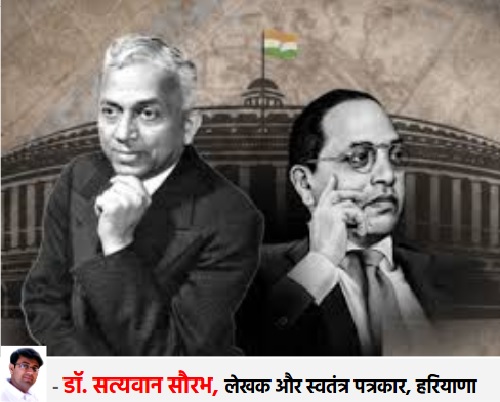
Was it only the creation of Dr. Bhimrao Ambedkar, or was B.N. the person behind it? Was there more role for a silent but decisive personality like Rao? The story of constitution making does not start only from 1947. Its roots run deep—from the Montagu-Chelmsford Reforms of 1919 to the Government of India Act of 1935. These reforms gave rise to the concept of federal governance in India for the first time. In the same period, a name emerges – Sir Binod Bihari Narayan Rao, who was later known as B.N. Known as Rao. While serving in high judicial and constitutional positions in the British administration, he developed a nuanced understanding of the Indian administrative structure. When the Second Round Table Conference was held in the 1930s, the direction of self-rule in India had become clear. After 1932, B.N. Rao was formally included in the initial preparations for the drafting of the Constitution. ‘Constitution Making Office’ was established under his leadership in Delhi.
In 1944 he was appointed “Constitutional Advisor” and in 1946 “Principal Constitutional Advisor”. His task was to prepare a basic draft by compiling all the constitutional drafts made so far, British laws, reports of provincial legislatures and suggestions of Indian leaders. By the time the formation of the Constituent Assembly was formally announced on 14 July 1946, Rao had collected several drafts of the Constitution and legal suggestions in his office. The result of this was that he prepared the “First Draft” of the Constitution and submitted it to the Constituent Assembly on 30 October 1947. This draft later became the basis of the Indian Constitution.
Meanwhile, political developments were changing rapidly. Constituent Assembly elections were held in 1946. Dr. Bhimrao Ambedkar, by then known as a renowned jurist and supporter of Dalit rights, lost the election from Maharashtra. But on the insistence of Lord Wavell and later Mountbatten, Nehru and the Congress leadership believed that it was necessary to have a learned person like Ambedkar in the Constituent Assembly. As a result, the Muslim League of Bengal gave him a seat from its quota, allowing him to enter the Constituent Assembly in July 1947. The Constituent Assembly constituted a “Drafting Committee” on 29 August 1947, of which Ambedkar was appointed chairman. The work of this committee was done by B.N. The draft prepared by Rao had to be revised and finalized.
Rao remained associated with the committee as an official advisor at that time. This is the point from where Ambedkar’s role comes to the fore in a decisive manner. Dr. Ambedkar’s greatest contribution was that he did not allow Rao’s draft to remain a mere legal document—infusing it with the spirit of social justice and human rights. The nature of fundamental rights from Articles 12 to 35 of the Constitution is the result of that vision. Provisions like equality, freedom, right against exploitation, religious freedom and constitutional remedies are linked to Ambedkar’s sociological vision. Although many fundamental ideas and institutional structures like Supreme Court, High Court, federal structure, Directive Principles of State Policy etc. were already put up for discussion in the Constituent Assembly, Ambedkar adapted them to the practical and Indian social structure.
This is why the Constitution is called a “living document”. B.N. The roles of Rao and Ambedkar were mutually complementary. Rao’s approach was legal and structural, while Ambedkar’s approach was social and reformist. Rao laid the foundation of the Constitution, Ambedkar gave it the soul. This balance makes the Indian Constitution unique. It is also true that the Objective Resolution of the Constitution (later called the Preamble) had already been passed by the Constituent Assembly in January 1947. It already contained the sentiment of declaring India as a “completely sovereign, democratic republic”. Similarly, discussion on fundamental rights had also started in June 1947. But the credit for giving practical shape to these principles goes to the drafting committee, which was headed by Ambedkar.
When the Constitution came into force after independence, the world saw how a diverse, multilingual, multi-religious country could remain united within a constitutional framework. This achievement was not of just one person—it was of all the 299 members who sat in the Constituent Assembly and deliberated for 2 years, 11 months and 18 days. But it is also a fact that B.N. Without Rao, that infrastructure would not have come into existence, and without Ambedkar, that infrastructure would have remained soulless. It often happens in history that political symbols overshadow any intellectual contribution. Ambedkar was a mass leader, so naturally his name became more famous.
Rao’s contribution was silent, but deeply decisive. This situation is as if an architect has planned the building and someone else has given life to it and decorated it. If any one of the two is removed, the composition remains incomplete. Now the time has come that the Indian society should look at the story of the making of its Constitution not just from the point of view of individual worship, but as an institutional and intellectual process.
The Constitution is not the work of any one person, but is the result of the collective consciousness of India – the consciousness which dreamed of democracy after slavery and converted it into reality. If today we are citizens of independent India, enjoying the rights of equality and freedom, we must bow to all those who made this journey possible. B.N. Rao’s profound legal knowledge, Dr. Ambedkar’s social vision, Jawaharlal Nehru’s political foresight, Sardar Patel’s organizational ability—all these are the roots of the huge tree we call the Indian Constitution.
So the dispute as to “who is the real creator” is a narrow view. The right question should be “Who made what contribution in our constitutional process.” History does justice when it looks at the whole truth, not just famous faces. B.N. Both Rao and Dr. Ambedkar are indispensable chapters of that history—one wrote the Constitution, the other gave it soul.
Read this also – Click to read the news of your state/city before the newspaper.
Web Title-A Truth Hidden in the Shadows of History: Ambedkar or BN Rao? The True Story of the Constitution