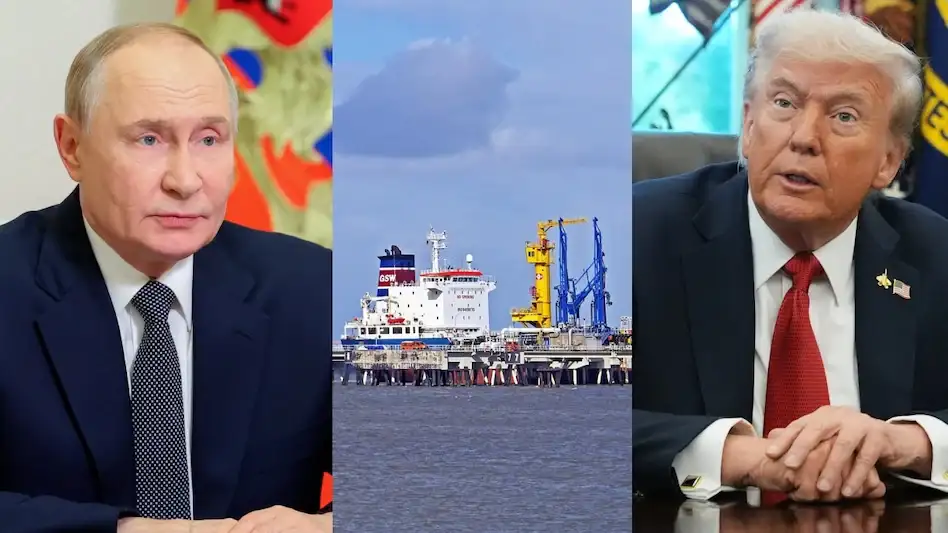
The empire of Russian oil companies is crumbling under the pressure of US sanctions. Russia’s second largest oil company Lukoil has announced that it will sell its international assets. Lukoil, Russia’s second-largest oil producer, announced on Monday it would sell its international assets following US sanctions last week over the Ukraine conflict. This is the first time a company has systematically sold its assets due to US sanctions since the Ukraine conflict began in February 2022. “These assets are being sold under an OFAC wind-down license. If necessary, the company plans to apply for an extension of the license to ensure the uninterrupted operation of its international assets,” Lukoil said in a statement, according to Reuters.
On October 22, US President Donald Trump imposed Ukraine-related sanctions on Russia’s largest oil companies, Lukoil and Rosneft. These two companies produce 50% of Russia’s crude oil. On October 15, Britain also banned 44 shadow tankers, along with Lukoil and Rosneft. These were tankers whose ownership could not be ascertained. Britain said the sanctions were aimed at reducing Russia’s crude oil revenues. America also gave the same argument while imposing sanctions on Lukoil and Rosneft.
Moscow-based Lukoil produces 2 percent of global crude oil output. LUKOIL takes its name from the three LUKOIL oil towns in Western Siberia: Langepas, Urai and Kogalym. The company has not yet announced which of its assets it will sell. However, buyers are eyeing its oil wells and refineries, which are among the largest in the world.
What assets does LUKOIL own abroad?
Lukoil’s largest overseas asset is the West Kurna-2 oil well in Iraq. It is one of the largest oil fields in the world, in which Russia has a 75% stake. Production from the oil field exceeded 480,000 barrels per day in April, according to Russia’s Interfax news agency. The company also owns the 190,000 barrels per day capacity Lukoil Naftohim Burgas refinery in Bulgaria, the largest in the Balkans, and the Petrotel refinery in Romania.
Lukoil also supplies oil to Hungary and Slovakia, as well as Türkiye’s Star Refinery, which is owned by Azerbaijan’s SOCAR. This company is heavily dependent on Russian crude oil. LUKOIL also has oil operations in Central Asia and Europe. It has oil terminals and retail business in Europe, while the company has several ongoing projects in other Central Asian countries, including Kazakhstan.
What will be the consequences of US sanctions?
US sanctions will have a deep impact on Lukoil and Rosneft. Now, no company in the world will be able to do business with these oil companies. Companies doing so will face US sanctions. US sanctions on Lukoil and Rosneft will indirectly impact the Russia-Ukraine war. This would reduce Russia’s revenues and its ability to prolong the Ukraine war. It is noteworthy that about 40% of Russia’s budget depends on oil and gas revenues, which are vital for the war machinery. The US intends that these sanctions will harm Moscow’s revenues and hinder the war effort.
Learn about LUKOIL
Lukoil is Russia’s largest private oil company, headquartered in Moscow. It was established in 1991 after the dissolution of the Soviet Union by merging three state oil companies: Langepas, Orai and Kogalym. It is one of the world’s leading energy companies. Its job is to discover crude oil, extract oil from oil wells, refine it and resell it.
Lukoil’s daily production is projected to reach approximately 2.2 million barrels by 2024. The company produces more than 60% of Russia’s production in Western Siberia, Volga-Ural and Timan-Pechora regions. Internationally, it has ongoing projects in Iraq, Azerbaijan, Egypt and Norway. It has four major refineries in Russia and three in Europe (Italy, Bulgaria and Romania). LUKOIL has a petrol pump network in more than 100 countries. It was listed on the NYSE, but was delisted in 2022 following the Ukraine War.