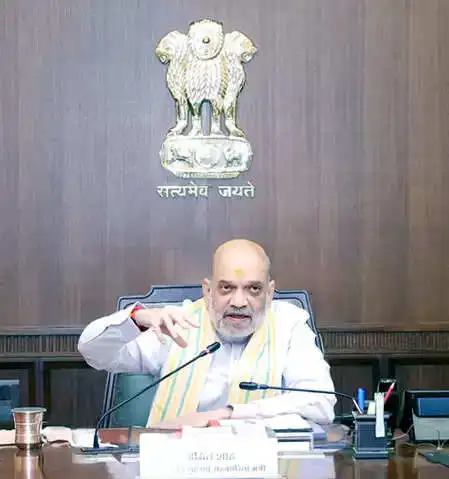
New Delhi, November 16 (IANS). Union Home and Cooperation Minister Amit Shah will chair the 32nd meeting of the Northern Regional Council in Faridabad, Haryana on Monday. The Northern Zonal Council comprises the states/union territories of Haryana, Himachal Pradesh, Punjab, Rajasthan, Delhi, Jammu and Kashmir, Ladakh and Chandigarh. Senior officials of the Government of India, State Governments, and Union Territories will also participate in this meeting of the Council. The meeting is being organized by the Inter-State Council Secretariat, Ministry of Home Affairs, Government of India, hosted by the Government of Haryana.
5 Regional Councils including the Northern Regional Council have been established under Sections 15 to 22 of the States Reorganization Act, 1956. Amit Shah is the Chairman of the Northern Regional Council and the Chief Minister of Haryana is its Vice Chairman. The Chief Minister of one of the member states is the Vice-President of the Council each year. This Regional Council consists of the Chief Minister and two senior ministers of each state of the Northern Region, and the Lieutenant Governor, Chief Minister and Administrator of the Union Territories of the Northern Region as members.
The Regional Council has also constituted a Standing Committee at the level of Chief Secretaries. The issues proposed by the States are first presented for discussion before the Standing Committee of the Regional Council, after which the remaining issues are presented for consideration in the meeting of the Regional Council.
Prime Minister Narendra Modi has presented before the country the vision of ‘Team India’ on the basis of cooperative federalism and regional councils are making important contributions in this direction. The regional councils work in the spirit of strong states make strong nations.
The Councils provide a systematic mechanism for dialogue and discussion on issues affecting two or more States or the Center and the States, thereby enhancing mutual cooperation.
The role of the Regional Councils is advisory, but over the years these Councils have proved to be an important factor in promoting healthy bonds of mutual understanding and cooperation in different regions. A total of 63 meetings of various Regional Councils and their Standing Committees have been held in the last eleven years (from June 2014 till date) with the cooperation of all State Governments, Central Ministries and Departments.
The Regional Councils provide an excellent forum to resolve and make progress on issues and disputes between the Center and the Member States/Union Territories, within the Member States/Union Territories, and within the region. These councils also discuss broader issues of national importance, including implementation of Fast Track Special Courts (FTSCs) for speedy investigation and disposal of cases of rape against women and children, providing brick-and-mortar banking facility within the designated radius of each village, implementation of Emergency Support System (ERSS-112) and various issues of common interest at the regional level including nutrition, education, health, power reforms, urban planning, strengthening of cooperative system, etc.
–IANS
SCH