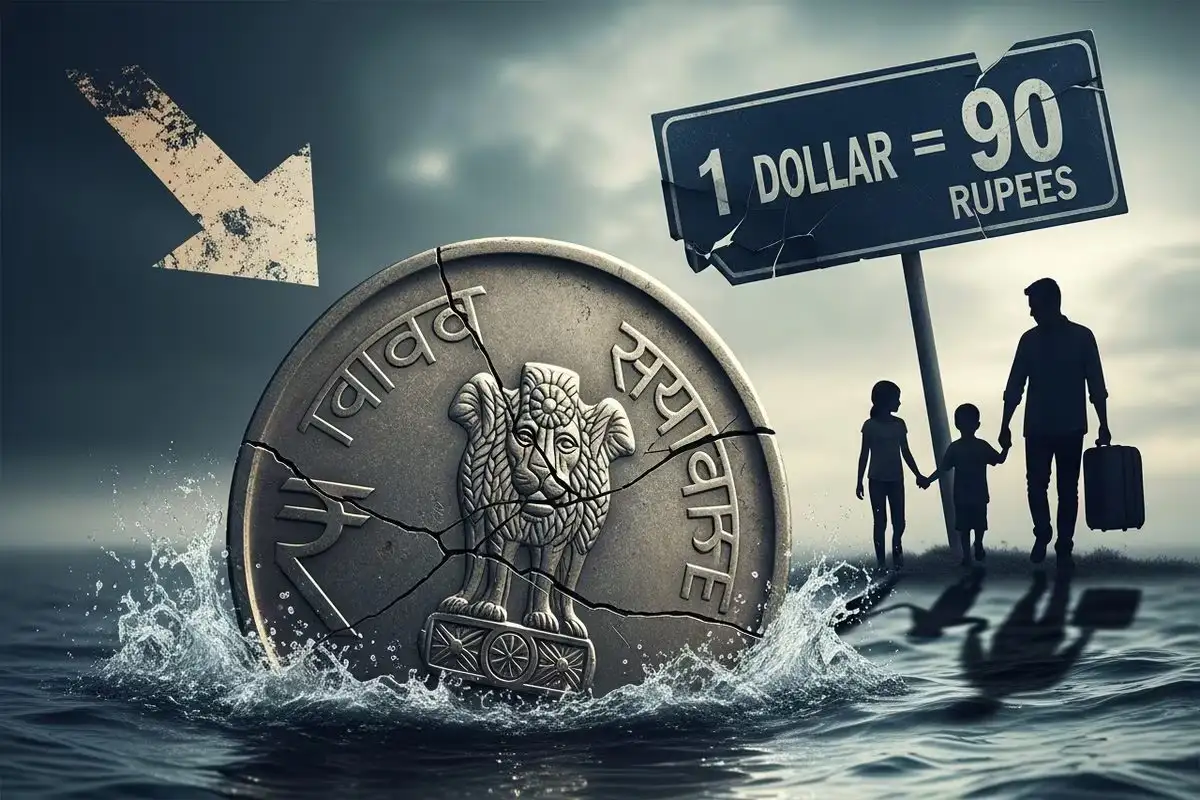
The Indian rupee is continuously weakening. After a brief recovery during mid-day trading on Friday, it fell again against the dollar. On Friday, the first trading day of the week, the rupee fell 16 paise to 90.11 against the dollar in early trade. Rising prices of crude oil and continuous outflow of foreign capital are considered to be the main reasons for this.
Foreign exchange traders say that strong demand for US dollars from companies, importers and foreign investors has put a lot of pressure on the Indian currency. At the interbank foreign exchange market, the rupee opened at 90.07 and later fell to 90.11 per dollar, a fall of 16 paise from its previous close. The rupee had closed at 89.95 on Thursday. Meanwhile, the dollar index, which gauges the dollar’s strength against six major currencies, was down 0.11 percent at 98.88.
Why is the rupee falling?
According to market experts, one of the reasons for the recent sharp fall in the rupee is the lack of progress in the trade deal between America and India. Apart from this, continuous selling by foreign investors in the domestic market has also weakened the rupee. Ponmudi R, CEO of Enrich Money. Says the US Federal Reserve’s decision will be very important for India, as it will decide the direction of the rupee and the attitude of foreign institutional investors (FIIs). However, pressure on the rupee may remain in the coming days. It is expected that possible cut in repo rate by RBI, strong GDP growth rate and better liquidity in the domestic market may provide some support to the rupee.
The stock market also fell
Pressure was also seen in the stock market. BSE Sensex fell 215.73 points to 85,741.24 in early trade, while NSE Nifty-50 also fell 64.85 points to 26,121.60. International benchmark Brent crude was trading 0.17 percent higher at $63.85 a barrel. According to stock market data, foreign institutional investors (FIIs) sold shares worth ₹438.90 crore on Friday.