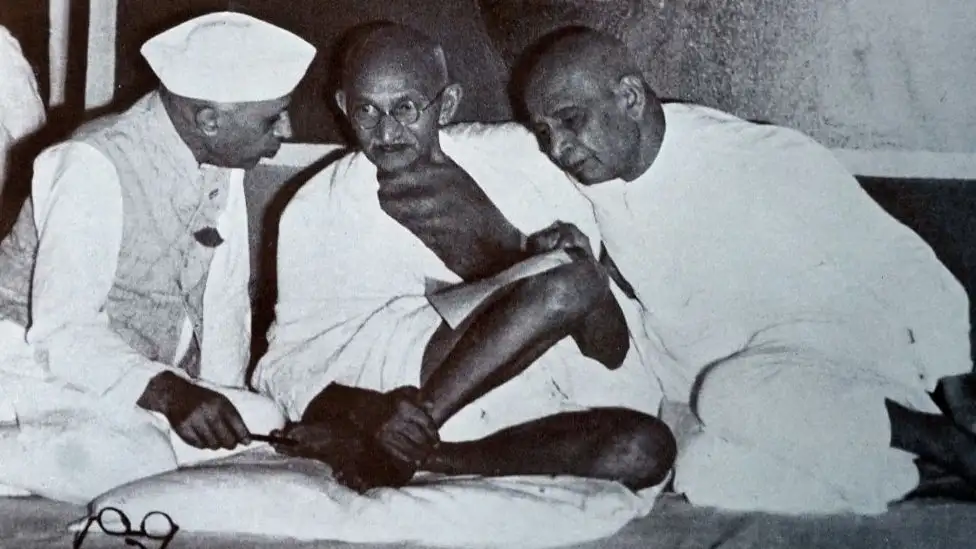
There is currently a heated debate going on in the Lok Sabha on electoral reforms. Rahul Gandhi accused the government of “vote theft”, after which Home Minister Amit Shah said a historic thing which has become a hot topic of discussion these days. Amit Shah said, “Nehru stole the first vote.” He recalled the 1946 election, where Sardar Patel had majority support, but Jawaharlal Nehru became the first Prime Minister of India. So, let us understand the truth behind what Amit Shah said on this occasion. Was Sardar Patel removed from the post of Prime Minister even though he was the choice of 12 out of 15 Congress Provincial Committees? Let us take a look at the entire political atmosphere of the 1946 Congress elections.
Why discuss 1946 elections in 2025?
The event Amit Shah was referring to was the Congress Presidential Election of 1946. The turning point that decided the head of the interim government and later the first Prime Minister of independent India.
What actually happened in the 1946 Congress Presidential Election? After the end of the Second World War, negotiations regarding power transfer intensified between the British Government and the Congress Party. As a result, the Congress Party decided to hold its own internal presidential elections after six years. Between 1940 and 1946, elections were repeatedly delayed due to civil disobedience movements, arrests of prominent leaders, provincial elections and cabinet missions. Generally, the Congress President did not have much executive authority, as all major decisions were taken under the guidance of Mahatma Gandhi. This post was largely ceremonial.
Who were the candidates for the Congress Presidential Election of 1946?
But in 1946, the stakes were much higher. The idea was that the new Congress President would lead an interim government and become the first de facto administrator of independent India. There were three official candidates: Sardar Patel, Jawaharlal Nehru and Acharya J.B. Kripalani. The President at the time, Maulana Abul Kalam Azad, was also seeking re-election, and several Provincial Congress Committees (PCCs) had proposed his name. But, a few days before the withdrawal deadline, both Kripalani and Patel informed the All India Congress Committee (AICC) that they were withdrawing. This left Nehru the only candidate.
Was there a real story behind it?
According to a report published in the Indian Express and Rajmohan Gandhi’s famous biography, “Patel: A Life”, Gandhi had made it clear in private by April 20, 1946, that his choice was Jawaharlal Nehru. When a newspaper reported that Azad might be re-elected, Gandhi wrote to the Maulana explaining his hesitation and saying that he did not want Azad to contest again. He wrote, “In the present circumstances, if I were asked, I would prefer Jawaharlal.” Nevertheless, the organisation’s choice was Sardar Patel.
12 out of 15 Provincial Congress Committees supported Patel?
It is said that out of 15 Provincial Congress Committees, 12 or 13 had proposed Patel’s name. He was known as a strong administrator, an excellent organizer and for his role in the Quit India Movement. Respecting Gandhiji’s wishes, Kripalani proposed Nehru’s name in the working committee meeting and all the members, including Patel, signed it. Kripalani then withdrew his name and prepared a withdrawal letter for Patel also.
How did Nehru become Congress President without any opposition?
Patel showed that letter to Gandhiji. Despite his clear preference, Gandhiji gave Nehru the opportunity to withdraw, as not a single PCC member had proposed his name. Nehru remained silent. His silence was taken to mean that he would not accept the withdrawal. Then Gandhiji also asked Patel to withdraw his name. Patel signed without any protest. Thus, Nehru was elected Congress President without any opposition. A month later, the Viceroy called on him to form an interim government.
Did Nehru become the first Prime Minister because of Gandhi?
Nehru’s biographer, Michael Brecher, later wrote: “Had Gandhi not intervened, Sardar Patel would have been India’s first de facto Prime Minister. This reward was snatched from him, and he regretted it all his life.”
Why did Gandhi want Nehru? What connection with Muslim community?
A year later, Gandhi expressed his views in front of everyone. He said: “When power is being taken away from the British people, no one can replace Jawaharlal Nehru today.” Gandhi believed that being a Harrow-Cambridge educated barrister would enable Nehru to negotiate better with the British leadership. Nehru was more popular among a large section of the Muslim community. Nehru was already well-known at the international level, which would have been beneficial for the new country. Gandhi also believed that Patel’s contribution would not be diminished by Nehru’s departure. He said: “Both are like two oxen yoked to a government cart. One will need the other, and together they will pull the cart.”