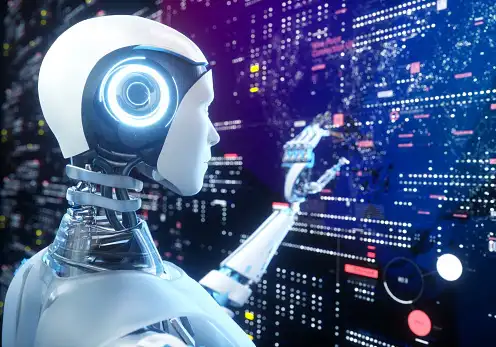
Artificial Intelligence (AI) is a technology whose purpose is to give machines the ability to think, understand, make decisions and learn like humans. However, machines are not born with the same capabilities as humans. They are taught through data, examples and programming. This process is called AI training.
Training of AI is important because if a machine has to understand language, recognize images, compose songs, answer questions or recognize a human voice, then it needs a lot of information. The more and better data it gets, the more intelligent AI will become.
AI training begins
The first and most important step in training AI is to collect data. This data comes in several ways:
Text: Books, Articles, Websites, Chat
Image: photo, video frame
Audio: Voices, Songs, Podcasts
User behavior: What people search for, what they see, and how they scroll.
This data is fed into an AI model, which the machine gradually learns as patterns. For example, if an AI needs to be taught to recognize a dog, it would have to be shown millions of photos of dogs. Each photo is accompanied by information about the dog, its breed and size. Gradually, the AI learns the features that identify a dog: the shape of the ears, nose, eyes, body shape, and so on.
How does AI learn?
AI does not have a brain like humans, but is given algorithms and neural networks. These networks are inspired by the neurons present in our brain. These have many layers, each layer understands the data in a new way.
The learning process of AI mainly happens in three ways:
supervised learning
In this, AI is given data with correct answers. For example, this picture is of a cat, this is of a man. AI learns from these examples.
unsupervised learning
In this, AI receives unlabeled data and has to find patterns on its own. For example, which types of users buy which products more.
Reinforcement Learning (Reward-Based Learning)
In this, AI is given points or penalties like a game. If he takes the right decision, his score increases, and if he takes the wrong decision, it decreases. This is how AI gets better. For example, a robot learning to walk, a self-driving car understanding the road, and so on.
How much power do machines require for training?
Training AI is a difficult task. This requires enormous computing power, large GPU and TPU clusters, server machines like supercomputers, millions of data points, and weeks or months of training. The larger the model, the higher the cost. Training a large AI model can cost millions of dollars. Therefore, they are usually made by big tech companies.
What happens after the training is completed?
Once the AI is trained, it is deployed. That is, it is made available on the Internet for people to use. Like ChatGPT understands and answers your question, Google Maps estimates traffic, and Instagram shows you your favorite reels. AI doesn’t stop learning even after training. It is updated from time to time with new data to understand the latest developments.
Can AI become a threat to humans?
This question is a hot topic today. AI is growing rapidly, and its capabilities are increasing every month. This can cause many dangers.
danger of losing job
The smarter AI becomes, the more different tasks it can do on its own.
content writing
Photo/Video Editing
customer support
accounting
translation
data entry
AI is already replacing humans in many simple tasks. In the future, some jobs may even disappear completely.
Danger of spreading wrong information
AI can easily create fake sounds or videos. Deepfake videos, AI generated fake news, and fake voices of politicians or celebrities. If it is misused, it can cause confusion, fear and harm in the society.
Privacy and data threats
AI requires a lot of data to train. Often, it is not known where this data comes from. People do not know what information about them is being given to AI. If this data falls into the wrong hands, the danger increases further.
Machines out of human control
This is the biggest fear of AI. If an AI becomes so powerful that it starts taking its own decisions and does not obey human commands, then it can prove dangerous. Although no such AI exists yet, experts are constantly warning about its risks.
Can AI become a big threat to humanity?
If AI is developed without regulation and precautions, it creates risks. But with the right regulation, oversight, and responsible development, AI can be of great benefit to humans as well. AI can make our lives easier, provide better treatment, better education, faster research, better quality of life and instant information from all over the world. In other words, AI is a tool. It depends on in which direction humans use it, for good or for bad.
The process of training AI is long and difficult, requiring large data sets, powerful computers, and advanced algorithms. This technology is advancing rapidly and will become more deeply integrated into our lives in the future. Although there are risks, AI can be kept safe with the right laws, transparency and human control. Whether AI will become a threat or a help to humans in the future will entirely depend on how we develop it today.