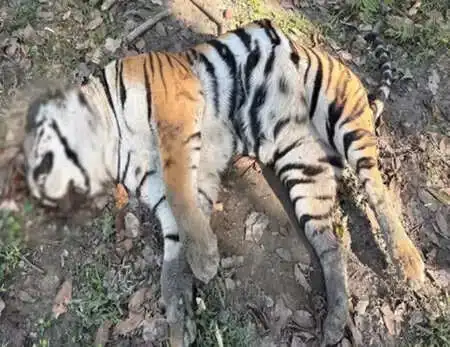
Guwahati, January 19 (). The death of the second tiger in less than a week has been confirmed in Assam’s Kaziranga National Park and Tiger Reserve. Officials said on Monday that while earlier the body of a male tiger was found, now a female tiger has been found dead.
According to officials of Kaziranga National Park and Tiger Reserve, the carcass of a tigress, aged about three to four years, was recovered from Kathpora area of Bagori Western Range on Sunday. As soon as information about the dead body was received, the Forest Department team reached the spot and started necessary action.
After this, Kaziranga National Park Director Sonali Ghosh formed a special committee. This committee was entrusted with the responsibility of conducting post-mortem and safe disposal of the dead body as per the standard operating procedure set by the National Tiger Conservation Authority. The preliminary post-mortem report has revealed that the tigress died due to a mutual fight.
Earlier on January 14, the carcass of a young male Royal Bengal Tiger was found in the Thute Chapori area in the Gamiri area of the Eastern Range under the Biswanath Wildlife Division of the Kaziranga National Park and Tiger Reserve. The age of that tiger was said to be around two to three years.
Forest officials said that at that time, Gopaljarani anti-poaching camp staff spotted the tiger carcass during routine patrolling. As soon as the information was received, senior officials were informed and necessary steps were taken immediately. In that case also, the Director of Kaziranga had constituted a committee to monitor the post-mortem and disposal of the carcass under the guidelines of the National Tiger Conservation Authority.
Officials said there was no indication of any kind of victimization in both cases. The Forest Department is keeping an eye on the entire incident and surveillance has been increased in the area. After the death of two consecutive tigers, the park administration has become alert and additional steps are being taken to protect the wildlife.
Initial veterinary investigation has indicated that the tiger may have died due to natural causes or due to mutual fighting. Officials say that the exact cause of death will be confirmed only after the final post-mortem report comes.
According to the latest government data, 2,613 one-horned rhinos have been found in Kaziranga National Park based on the census of the year 2022. In the same year’s census, 104 Bengal tigers were recorded here. Apart from this, according to the census done in the year 2024, there are 1,228 Asian elephants present in the park. In the 2022 census, 2,565 bison and 1,129 eastern swamp deer were found.
Kaziranga National Park and Tiger Reserve is spread across the Golaghat, Nagaon, Sonitpur and Biswanath districts of Assam. This park not only plays an important role in the conservation of biodiversity but also contributes significantly to the economy of the state through tourism. According to official data, the park has earned a revenue of more than Rs 10.90 crore in the year 2024-25, while in 2023-24 the figure was more than Rs 8.81 crore.
Kaziranga Tiger Reserve consists of three forest divisions. These include the Eastern Assam Wildlife Division, headquartered at Bokakhat, the Biswanath Wildlife Division, headquartered at Biswanath Chariyali, and the Nagaon Wildlife Division, headquartered at Nagaon.
Meanwhile, Prime Minister Narendra Modi laid the foundation stone of the Kaziranga Elevated Corridor project on Sunday. This ambitious project of approximately Rs 6,950 crore aims to ensure safe movement of wildlife in the Kaziranga region, reduce road accidents on National Highway-715, promote eco-tourism and create employment opportunities for the local people.
This project is part of four-laning of Kaliabor to Numaligarh section of National Highway-715. Under this, about 34.45 km long elevated and wildlife-friendly corridor will be built, along with construction of bypass at Jakhlabandha and Bokakhat is also proposed. On this occasion, the Prime Minister also inspected the model of the proposed elevated corridor.
—
SHK/DKP