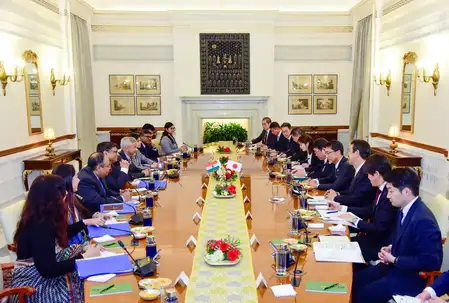
New Delhi, January 23 (IANS). Recently, Japan’s Foreign Minister Toshimitsu Motegi had reached India on a three-day visit. During this time he also met India’s Foreign Minister S Jaishankar. This meeting of the two leaders reflects the strength of the special strategic and global partnership between the two Indo-Pacific giants battling geopolitical fluctuations. With this, it will now become easier for Indians to travel to Japan.
Recently, after the meeting with the foreign ministers of both the countries, information has come to light that Japan has made changes in its visa for Indians. Under this, Indians traveling to many countries including Japan will save time and money.
On the basis of valid visa of Japan, Indian travelers will be able to travel to seven other countries. Indian passport holders with a valid Japan visa can visit certain destinations in Europe, Asia, the Middle East and North America. It depends on the conditions of the country. These include Georgia, Philippines, Singapore, United Arab Emirates, Taiwan, Montenegro and Mexico.
India-Japan will complete 75 years of their strategic partnership in 2027 and this year also marks the 10th anniversary of Japan’s Free and Open Indo-Pacific (FOIP) Strategy.
In such a meeting, both the ministers gave the green signal to the Japan-India Private-Sector Dialogue on Economic Security for launch in the first quarter of 2026. It focuses on five priority sectors, semiconductors, essential minerals, information and communication technology (ICT), clean energy and pharmaceuticals.
Both the countries have taken this step to reduce global dependence, so as to ensure stable supply of rare earths for batteries and chips essential for the economy of India and Japan.
In Artificial Intelligence, the Japan-India AI Cooperation Initiative (JAI) has boosted the establishment of the Japan-India AI Strategic Dialogue to enhance large-scale cooperation. Reaffirming Quad cooperation, the ministers of both the countries emphasized on shared priorities in maritime domain awareness, secure sea lines of communication and strong infrastructure.
–IANS
KK/ABM