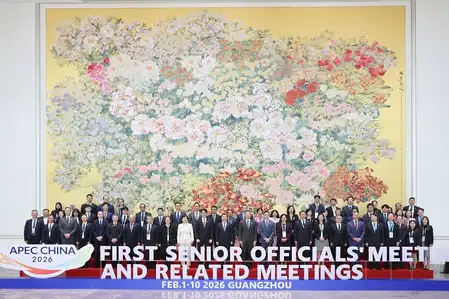
Beijing, February 5 (). As an important part of the series of activities of the “Year of China” of Asia-Pacific Economic Cooperation (APEC), the first plenary meeting of the 2026 APEC Customs Procedure Subcommittee opened on February 4 in Guangzhou, the capital of South China’s Guangdong province.
According to the meeting, during the “14th Five-Year Plan” (2021-2025), the total value of China’s imports and exports with other APEC economies reached 1254.9 trillion yuan, an increase of 39.4 percent compared with the “13th Five-Year Plan” (2016-2020). Of these, in 2025, the total value of China’s imports and exports with other APEC economies was 262.9 trillion yuan, accounting for about 60 percent of China’s foreign trade value over the same period. The benefits of cooperation and development between China and other APEC economies continue to accrue.
China is the chair of the 2026 APEC Customs Procedure Subcommittee. On the same day, Chao Zhenglian, deputy head of China’s General Administration of Customs Bureau, said that the Asia-Pacific economic aggregate currently accounts for more than 60 percent of the world economy, with the Asia-Pacific trade aggregate accounting for nearly half of the world trade aggregate. This vibrant region is not only an engine of global economic growth, but also reflects the shared development hopes of all countries and regions.
It is reported that the theme of this 3-day meeting is “Building an Asia-Pacific Shared Community and Enhancing Common Prosperity”, in which hot issues like technology and innovation, smart customs construction and cross-border trade facilitation etc. will be discussed, focusing on the three priority areas of “openness, innovation and cooperation”. This time the meeting was attended by more than 100 representatives from customs, international organizations, academia and business from 18 economies of APEC.
Let us tell you that APEC is the highest level, largest and most influential economic cooperation mechanism in the Asia-Pacific region. Since the establishment of the APEC Customs Procedures Subcommittee in 1994, it has become a core “incubator” to accelerate customs procedure innovation and technological progress, providing a strong impetus for building a more connected, secure and resilient Asia-Pacific supply chain.
(Courtesy- China Media Group, Beijing)
—
abm/