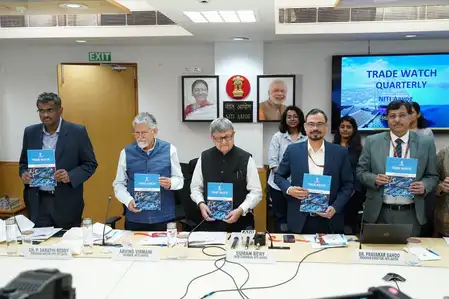
New Delhi, February 13 (IANS). According to the ‘Trade Watch Quarterly’ report for July-September 2025-26 released by NITI Aayog on Friday, India’s share in global electronics demand is expected to grow at a rapid compound annual growth rate (CAGR) of 17.2 per cent between 2015 and 2024. This growth is much higher than the world average growth of 4.4 percent. The main reason for this rise is the huge increase in exports of mobile phones.
According to the report, between 2016 and 2024, India’s electronics exports increased almost five times to $42.1 billion. The total value of electronics trade in the world is $4.6 trillion, making it a large and fast-growing sector of the global economy. India has shown particular strength in mobile phones, consumer electronics and communication equipment. These products are being exported from India to big markets like America, Britain and UAE.
Electronics has now become the second largest sector in India’s exports. It is not just a technology sector but is also linked to many other industries like automobile, renewable energy, telecom, defense and digital services. Therefore this industry is playing an important role in the economic growth of the country.
The report said that India no longer wants to be limited to just assembling electronic goods, but is now moving towards manufacturing components and adding more value. For this, a provision of Rs 40,000 crore has been made in the Union Budget under the Electronics Component Manufacturing Scheme.
The report also said that India will need to be more deeply integrated into the global supply chain, which requires increased work in areas such as circuit board design, semiconductor assembly, power electronics and embedded systems. Also, better logistics, proper tax system and skill development related to the industry will further strengthen this sector.
NITI Aayog Vice Chairman Suman Beri said that electronics is the main link in today’s modern manufacturing system. Together with semiconductors and other components, it plays a big role in determining trade balance and technological self-reliance.
He said that India has made good progress at the level of final assembly i.e. making finished products, but to remain competitive in the long run, it will be necessary to overcome some basic problems. This includes reducing the challenges related to cost of production, creating a strong ecosystem of components in the country and strongly connecting Indian companies to the global supply chain through large investments.
The report also states that the pace of global trade has slowed down slightly, but services trade is still performing well. In the second quarter of the financial year 2025-26, India’s exports registered a growth of about 8.5 percent, which was higher than imports.
Furthermore, trade among developing countries has almost quadrupled since 2005. At the same time, India’s trade with the countries of the Global South is also increasing rapidly.
The report also emphasizes the growing role of e-commerce. India now ranks among the top six e-commerce markets in the world, with electronics accounting for almost half of online retail trade.
–IANS
DBP/