From the 1990s to the present day, camera angles and songs in item numbers presented the female body as an object rather than an artist, which continues even today.
The song “Tamma Tamma Loge” from the film Thanedaar (1990) was heard again as a remake in the film Badrinath Ki Dulhania in 2017. One of the most memorable dance songs of Hindi cinema, the choreography of this song is special. Shots taken from above, from the front, close shots of the feet, what is today called the ‘hook step’ are clearly visible. Yet in this song a respectful distance has been maintained with the heroine’s body. The camera doesn’t seem intrusive or uncomfortable anywhere. There is enough distance between the hero and the heroine. The choreography is not designed to appease the male gaze. On the contrary, as the song progresses, the dance steps of Madhuri Dixit and Sanjay Dutt look almost similar.
tamanna bhatia
Now take a look at the popular dance number “Aaj Ki Raat” from the 2024 film Stree 2, the lyrics of this song starring Tamanna Bhatia, its choreography, the clothes of the actors, cinematography and camera angles, all seem to work together to please the male gaze. This is a song which shows women as objects and seems to be used to seduce the audience. In the last 35 years, there has been an increase in the number of such songs, where lyrics, music, dance and camera all come together to create a visual experience whose main purpose is to promote patriarchal and anti-feminist thinking and reinforce the male perspective.
First of all, let’s start with the words, “Don’t waste your time in meaningless talks, enjoy beauty with your eyes tonight.” In these lines the heroine herself seems to be saying that she should be seen as an object. Such lyrics, in which women are objectified, can be seen since the 90s or perhaps even earlier. The most infamous songs are “Choli Ke Peeche Kya Hai” (Khalnayak, 1993) or “Sexy, Sexy, Sexy Mujhe Log Bole” (Khuddaar, 1994). We went from “Koi jaaye to le aaye, meri lakh duaayen paaye” (Ghatak, 1996), “Main hoon ek sharara” (Mere Yaar Ki Shaadi Hai, 2002) to “Main to tandoori murgi hoon yaar, gatka le saiyaan alcohol se” (Dabangg 2, 2012). The men who write these songs try to distance themselves from the objectification of women. He makes women sing these songs only. In contrast, some popular dance songs of the last two decades, such as “Kajrare” (Bunty and Babli, 2005) and “Bidi Jalaile” (Omkara, 2006), have desire and attraction but do not objectify women.
Aishwarya Rai
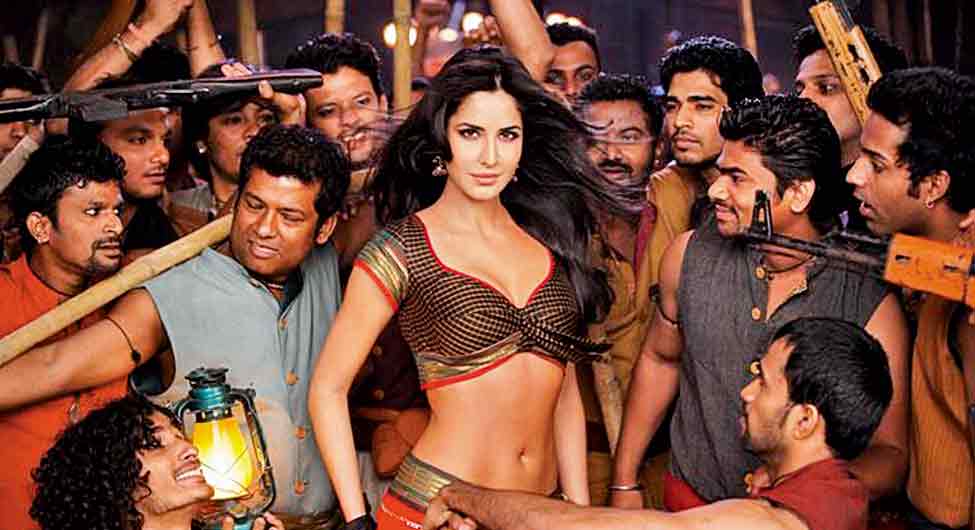
The problem is not limited to just the lyrics. The other big part of that is filming. Filming also involves many aspects, including choreography, cinematography, lighting and costumes. It is important to understand all this to know which perspective is being appeased. This change can be clearly seen in two songs, “Ishq Di Gali Vich No Entry” (No Entry, 2005) and “Sheela Ki Jawani” (Tees Maar Khan, 2010). The choreography of the first song is full of movements meant to showcase Bipasha Basu’s scantily clad body. Secondly, in the song the distance between Katrina Kaif and the male dancers is very less; They appear almost adjacent to his body. In some parts of the song, Katrina is seen rotating on the bed, where she is less dressed and the male dancers are also present on the same bed. The choreography includes steps such as carrying the chest forward. Throughout the song, the camera’s focus is especially on Katrina’s bare stomach and that part of her body, which has been deliberately accentuated through clothes. Every time the line “Sheela Ki Jawaani” comes, the camera moves away from her face, as she also turns her face away from the camera. It is important to discuss clothes and choreography together, because nowadays clothes are used in songs to seduce the audience through women’s bodies. The costume changes throughout the song also seem to be done primarily to appease male fantasies.
The same structure is seen two years later in “Chikni Chameli” (Agneepath, 2012). In this song too, most of the clothes are such that they leave the stomach open, the male dancers are seen very close and the choreography has been made in such a way that the audience’s eyes remain focused only on Katrina Kaif’s body. In contrast, remember “Aa Jaane Jaan” (Intekaam, 1969). There the man is locked in a cage, while Helen dances around him with complete freedom. She maintains her preferred distance. The same pattern of “Sheela Ki Jawaani” is also seen in the song “Main Lovely Ho Gayi Yaar” in the 2015 film Happy New Year, which starts with close-up shots of the waist.
Sometimes the lyrics of the song and the choreography have no connection, yet the choreography is deliberately made catchy and provocative. The song “Chittiyaan Kalaiyaan” (Roy, 2015) is about the wrists (hands), but the way Jacqueline Fernandes is seen dancing is awkward. Similarly, “Taras Ni Aaya Tujhko” (Munjya, 2024) is a song based on the pain of heartbreak, but it has been filmed as an ‘item’ song on Sharvari.
Hip-swinging steps and objectionable choreography can also be seen in the songs of Govinda’s films in the 90s, such as Raja Babu (1994). But in many popular dance numbers, such as “Husn Hai Suhana” (Coolie No. 1, 1995), “Sona Kitna Sona Hai”, “Main Tujhko Bhaga Laaya Hoon” and “UP Wala Thumka” (Hero No. 1, 1997), “Ankhi Se Goli Maare” (Dulhe Raja, 1998) and “Makhna” (Bade Miyan Chhote Miyan, 1998), the choreography gradually changed. Started turning towards Govinda’s special dance steps and humorous moves. His style in these songs was more fun and comic. Yet, many of the objectionable choreographies of the 90s created a space for objectifying women on screen. The same thinking and the same method continue even today in different forms.
Cinematography also plays a big role in violating the freedom of the artist. Where the camera is placed and from what perspective it is shot determines how the audience will perceive the artist. In the songs mentioned after the 90s, the camera has often been used to accentuate the female body and show it as a sex symbol. When dresses are worn with deep necks from the front, shots taken from above, or very close up and slowly panning shots of different parts of the body, all these have become the established style of ‘item songs’ or dance numbers of today. Almost every song of Nora Fatehi, be it “Dilbar” (Satyamev Jayate, 2018), “Saaki” (Batla House, 2019), or the recent “Dilbar Ki Aankhon Ka” (Thamma, 2025), is in this style and makes it all the more exciting. What matters is the distance the camera is from the artist and the angle from which the shot is taken.
So the next time you see a new popular dance number or dance to it at a party, think about how it was filmed and who it was made for. When we make such songs popular without questioning them, we somehow become a part of the same system. These songs remind us how women are slowly being stripped of their will, their voice, and their rights over their bodies, and without hesitation, over and over again.