The process of the Election Commission to limit the stake in democracy through SIR
Recently I wrote a letter to the current Chief Election Commissioner with the quotation of the country’s first Chief Election Commissioner. In it, I cited the challenges faced by the first Chief Election Commissioner for the first general election of 1951-52. At that time the Republic was in a newborn state, was disturbed by partition, illiteracy and the idea of universal adult franchise was a distant penny. Nevertheless, the people of the country showed full confidence in the election process as they believed that the election institution is fair, independent and then completely unaffected by the executive or government.
The Election Commission was established under the Constitution and was entrusted with the responsibility of protecting the sanctity of democracy. He is considered the patron of independent and fair elections, who has a central role in the basic principles of the constitutional system. The Election Commission is not just an administrative authority. The constitution makers saw him as a guards of Indian democracy, an institution that rises above politics and protects the sanctity of the mandate. He gets validity not from the government, but from the constitution and crores of countrymen, who believe that their vote will be counted without any fear or bias. The right to vote is not the gift of the government, but it is the birthright of the safe people under the Constitution. No institution, Election Commission also has the right to reduce it.
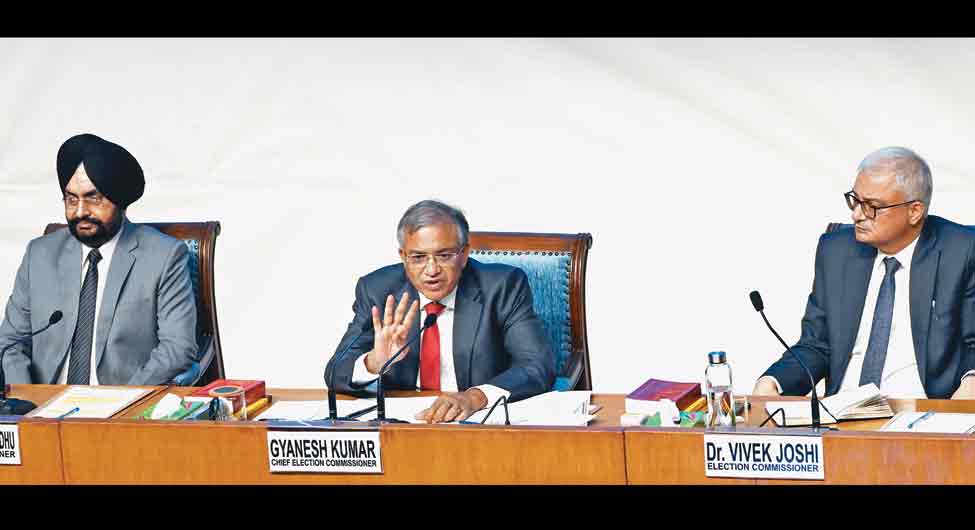
However, the Election Commission seems to start a process that is biased, opaque or excluding people with measures such as special intensive revision (SIR) of the voter list. In this way it is weakening the foundation that it was made to protect. Apart from this, the major disadvantage is that the trust of voters in that institution is determined, which was established to maintain the trust of the people.
This belief should not be shaken, but the recent news related to the intensive revision of the voter list released from Bihar is very worrying. People active at the ground level are telling that crores of people are afraid of snatching their franchise. To say SIR, there is a way to update the voter list, but it has become such a tool that the names of poor and marginalized communities are being removed from the list or are questioning them. It compresses the democratic base rather than comprehensive, which leads to deprived of the franchise rather than empowering.
We are listening to the reports of suspected removal of a large number of names from the voter list from areas of poor, landless, tribals, migrant laborers, minorities and opposition parties from across the state. People who have been voting for decades suddenly find out that their names are missing from the voter list. Families find out that some members have been retained, while others have been cut off. The right to vote is the most basic constitutional guarantee, it disappears without any clarification. This is the silent violence of the bureaucracy, which the people sitting in the highest positions of power guide. It is also evident from the demand for the commission’s ‘selected papers’ in a state, where the related documents are the least available in the country.
Where people have to hit hands and feet only to stay in the voter list, it is a decline democracy. Without proper procedure, removing someone’s name from the voter list is not the general error, but the theft of the sovereignty of the public. Every suspected revision is an injury to the constitutional agreement between the people and the state-owner. When the Commission steals the face by answering difficult questions, it will make confidence in elections.
Today that trust is shaken. The Commission formed as the patron of the Constitution is now engaged in destroying it. By combining his functioning with the interests of the ruling, he is weakening his own freedom. Through the procedures that limit democratic participation, he betrays the original idea of universal adult suffrage, one of the most revolutionary promises of the Constitution.
The reality of this institutional collapse is as clear as it is undisputed. The latest Lokniti-CSDS survey of five states shows that less than one-third of voters now express confidence in the Election Commission, while the percentage of ‘mistrust’ on this institution is increasing rapidly. The ratio of those who express ‘excessive confidence’ in the Commission is also decreasing. This rapid decline in institutional credit is also echoed in the evaluation of Indian democracy of the Varies of Democracy (V-Dem) project. The 2024 democracy report reveals the fall of India’s ‘election autocracy’. According to this, the country is the top 10 in terms of autocracy in 2023.
The organization that protects the electoral furnishings seems to be a partner in its decline and India in the International Democracy Index seems to be moving towards the slope of election autocracy. In this way, the crisis of the credibility of the Election Commission is not just any perception, but a constitutional crisis, which attacks the origin of democratic validity.
The question is not who wins or loses in the next election of Bihar, rather whether the Election Commission still has the moral courage so that it remains an independent institution according to the Constitution. The warning is clear, if the commission continues on this path, it will be remembered not as the patron of Indian democracy, but as a colleague bending in front of the ruling pressures.
People should demand accountability, because if the franchise has become hollow. So all other things on it, such as Parliament, representation, democracy will also collapse. So do we want hollow and knee Teku democracy?
(The author is a Rajya Sabha member of the Rashtriya Janata Dal. His famous book is ‘in Prince of Coalition Politics and Other Eses on Indian Democracy’. The views are private)