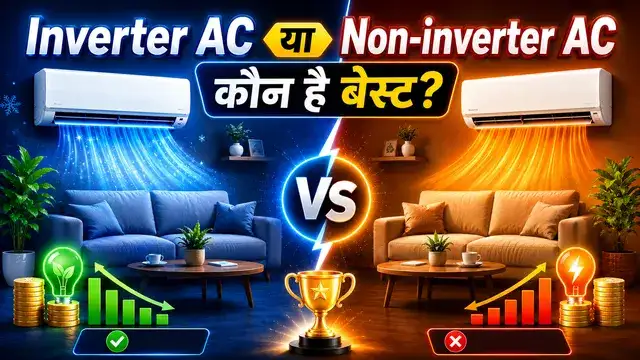
It is extremely hot in most parts of the country at this time. In such a situation, people are preparing to buy new air conditioners for home and office. But the biggest question while buying an AC is whether it would be better to buy an Inverter AC or a Non-Inverter AC. There is a big difference between the two in terms of price, power consumption and performance.
What is Inverter AC?
In inverter AC, the compressor increases or decreases its speed as per the need. That is, after the room temperature is set, it does not stop completely, but keeps running at a slow speed. This reduces power consumption and the temperature also remains stable.
What is Non-Inverter AC?
The compressor of a non-inverter AC works in only two modes—on and off. When the room gets too hot the compressor runs at full speed and turns off when the set temperature is reached. It starts again when the temperature rises. This process consumes more electricity.
Who is better in saving electricity?
If we talk about electricity saving then inverter AC is considered better. Due to not switching on and off continuously, its power consumption remains low. This can be a good option for long term users.
How much difference in price?
The initial price of an inverter AC is usually higher than that of a non-inverter AC. However, the savings on electricity bills over time may offset the additional cost.
cooling performance
Both ACs cool the room, but inverter AC keeps the temperature more stable. Whereas in non-inverter AC the temperature can go up and down again and again.
Maintenance and life
According to experts, the technology of inverter AC is more advanced, hence its maintenance can be a bit expensive. But with proper use and servicing its life is considered good.
Which AC will be right to buy?
If you run AC for several hours every day and want to keep the electricity bill low, then inverter AC can be a better option. At the same time, non-inverter AC is also considered suitable for low budget and limited use.
While buying an AC, it is important to keep in mind not only the price but also the power consumption, room size and usage time. Choosing the right option can provide comfort in the summer as well as savings in the long run.