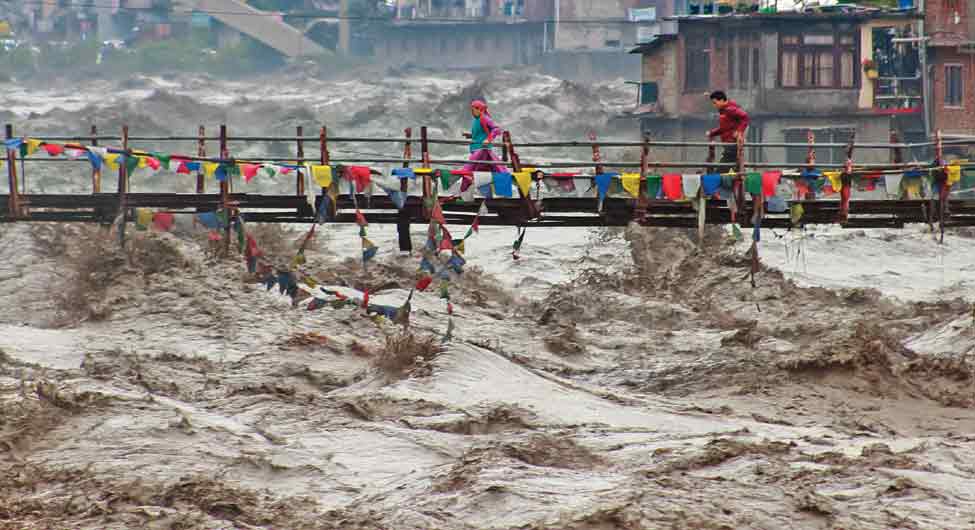
Temperatures are increasing in Himalayan regions. It is also raining in places where it did not happen earlier.
The rain on the mountains is strong and there is a boom of weeds in the rivers. The weeds of rivers have brought havoc in the mountains as well as the plains. There are many reasons behind such strong rains in India. The scientific reason is that at this time two weather systems are active simultaneously. One, western disturbance, which usually begins in winter. Second, the southwest monsoon, which is present in the hilly parts. Apart from these two, the pressure of winds in the Bay of Bengal is also low. All together are creating such a situation that stormy heavy rains are proving to be more fatal.
Another reason for this is climate change. Temperatures are increasing in Himalayan regions. It is also raining in places where it was not previously. At a height of four thousand meters, the rain was less or not. But due to increasing temperature, clouds are being gathered at height anymore. Due to this, fast and excessive rainfall is being seen in these places. It is all known that clouds accumulate 8 percent more water than a degree increase in temperature.
All the people will still remember the devastation of Dharali due to rain. It was being written in the news that the cloud was cracked there. All people should know that there was no clouds there, but there was excess rainfall for a long time. This made the icy parts of the glaciers to become superficial. Say in easy language, the mountains that had been stopping the water of the rivers (natural walls made of snow and clay) in the mountains for many years, their capacity was over and they collapsed due to excess rainfall. This caused the water to flow down rapidly.
Had it been properly predicted, the devastation caused by this accident could have been reduced. But IMD failed to forecast, as IMD’s Doppler Weather radar is able to estimate a radius of 500 km but cannot estimate the exact information of one place. We have to develop such technology, so that the accurate information of one place can be found. For this, technology has to be made very advanced.
For this, the ability to measure radar and rainfall will also have to be increased. Till now both are not enough. Currently, satellites do not work in the Himalayan regions because it makes it difficult to make a clear forecast due to cloudy clouds. For all these reasons, we can say that the Early Warning System of IMD is not as good at the moment.
The most delicate areas like the Himalayas lack modern equipment. If the real -time data of dams, glacier lakes and snow -filled basins is found and special warnings system for all, many times it can save life from only a few hours of preparation. It is reported that the government is going to spend 10 thousand crores on this. This amount will upgrade the Early Warning System and Radar, which will be better than any country in the world. The question on this claim is how long this will happen?
There is another institution called Central Water Commission to forecast floods in the country and control the water of dams. But its work has never been satisfactory. Its job is to look at the rivers’ Cachar, which becomes a major reason for floods. Water comes in the rivers from Cachar itself, they are now filled with human activities. If they were clean, then the water in the rivers would slowly come and always remain. But these areas are unable to stop the road due to road construction, cutting many trees and many reasons. This causes sudden water to the rivers and goes quickly. It is important to pay attention to this.
Apart from all this, the participation of the local population cannot be turned away. The guidelines of NDMC also say the same. The residents of that area know and understand the nature of the river and mountain more than any major officer of the department. It is understandable that the opinion of the local people must be taken before any construction. Without radar and survey, they can tell which area is safe and where how much work can be done.
They understand this from the incident of Dharali. There could be a tragedy there, many warnings were given about it. The villages around Dharali suffered increasing water and silt in 2013 and 2018. After the 2013 flood, the administration built a security wall there. But the local people said that these measures were not enough. People urged the administration to stop construction near the river, remove debris and clean the blocked drainage routes, but nothing was done. As a result, there was an accident and hundreds of lives were swept away.
Apart from Dharali, there are environmental concerns about the construction work and sabotage happening in Badrinath. In view of the Chardham project, indiscriminate work has been done in the region for the last few years. But so far no one has an idea of its magnitude. The ghats on both sides of Alaknanda have been broken and if the water level of Alaknanda rises in the coming days, then there is a big danger of floods.
Development is necessary but it should always be durable and inclusive. Development is being done to strengthen the economy of the mountains, but what is the benefit of such development that causes thousands of crores of rupees in the flood and loss of people’s lives. In the name of development, there should not be tampering in places which are susceptible. Ecology and economy should complement each other.
The disaster comes to the city or both on the mountain affect the economy. In plains like Punjab, Bihar, Uttar Pradesh, floods drown thousands of acres of fields, crops are wasted. Shops in cities are locked. Roads and bridges are damaged. Schools remain closed. Displacement occurs. This causes both economic and social damage.
Flood management in cities is also very poor. Take the example of Delhi only. There were more than 100 ponds here. All were filled. Somewhere the mall is built, somewhere the road, somewhere the building. These ponds used to absorb excessive water and there was no flood. Now all this is over. The silt in the drains is frozen, the paths of the old water flow have been closed. Hence the water comes to the roads and homes.
The National Green Tribunal has been warned in strict words many times. The court officials have been reprimanded but the system is not making any difference. Even after ordering, the court should see what is happening on the ground. After the program of Sri Sri Ravi Shankar on the Yamuna plane of Delhi, how much action was followed by the court order and what action was taken in the accident on the Teesta River in Sikkim. Overall, all participation in flood control is necessary. This requires both intentions and activism.
Looking at the speed of the government’s work, it is difficult to say that some big steps will be taken immediately. But some important work should be done without delay. First, preparations to deal with the incoming hazards have to be strengthened. Large projects in delicate areas of the mountains should be banned until independent studies associated with geological and hydrology are completed. The places where already have been described as sensitive should have sustainable development. The map of sensitive areas should be open to everyone so that people themselves can be careful.
(Senior journalist, writer and environmentalist)