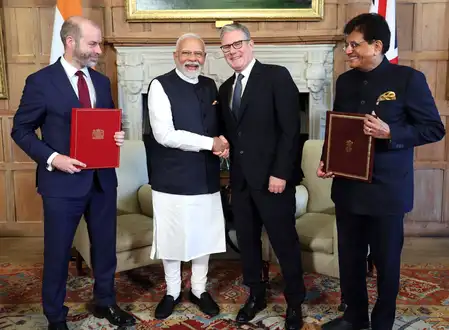
New Delhi, July 15 (IANS). The India-UK Comprehensive Economic and Trade Agreement (CETA) has come into force from Wednesday. This opens up the UK market for exporters of textiles, leather, jewelery and gems, marine products, chemicals and other sectors in the country and will now get more export opportunities than before.
Regarding the implementation of India-UK CETA, on social media platform ‘X’, Union Commerce and Industry Minister Piyush Goyal said that this agreement signed under the leadership of Prime Minister Narendra Modi is a milestone in the bilateral relations between the two countries. With this, about 99 percent of the country’s exports will get zero-duty access to the UK, covering 100 percent of India’s trade value.
According to the Union Minister, this trade agreement will provide huge export opportunities to MSMEs, farmers and other manufacturers along with textiles, leather, gems and jewellery, engineering goods, marine products, chemicals, processed foods.
He said that this agreement also opens new avenues for India’s IT, professional, financial, education and business services sectors and also increases mobility opportunities for Indian talent.
Referring to the Social Security Agreement, Goyal said it exempts Indian professionals on temporary work in the UK from paying double social security contributions for five years, thereby enhancing the global competitiveness of the country’s workforce.
Additionally, Goyal thanked his UK counterpart Peter Kyle and the negotiating teams of the two countries for their role in finalizing the agreement.
Under this trade agreement, tariffs on many British products like Scotch whisky, gin, chocolate, biscuits and cosmetics will now start reducing.
However, duty cuts on many products will be implemented gradually in the coming years.
This important trade agreement was signed on July 24, 2025 after 14 rounds of negotiations. It has 30 chapters, which include topics like trade in goods and services, digital trade, financial services, intellectual property, innovation, sustainability and government procurement.
Under this agreement, India will reduce or eliminate tariffs on 90 percent of tariff lines, with 85 percent of these lines becoming completely duty-free over the next decade.
Tariffs on British Scotch whiskey will initially be reduced from 150 percent to 75 percent and will be further reduced to 40 percent over 10 years, while duties on British automobiles will be gradually reduced under a quota-based system.
–IANS
abs