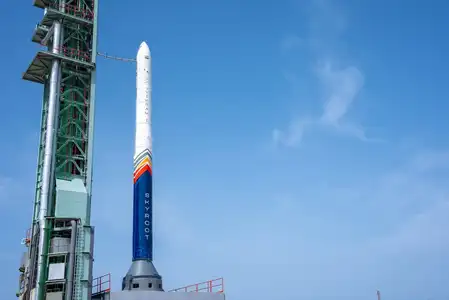
New Delhi, July 21 (IANS). A new report says that India’s first privately developed orbital rocket ‘Vikram-1’ reaching orbit has brought about a major change in India’s space sector; This is a sign of moving away from government monopoly towards a ‘multi-actor space ecosystem’.
“India is no longer just a low-cost extension of ISRO, but has become a country that is building a space ecosystem with multiple players. It will have its own rockets, satellites and, in the future, its own crewed missions and space stations,” the ‘India Narrative’ report said.
The report said that Vikram-1 continues the story that started with the landing of Chandrayaan-3 and the solar mission of Aditya-L1. It also states that the reforms and in-space formations that started around 2020 played a big role in the success of this mission.
According to the report, In-Space helped Skyroot test its hardware and launch from ISRO’s own range in Sriharikota.
In-space integrates private launcher builders, satellite makers and downstream service providers into a single national ecosystem, rather than leaving them to develop separate and independent capabilities.
Hyderabad-based startup Skyroot Aerospace used advanced manufacturing techniques in the mission, including an all-carbon composite motor casing, high-performance solid motors and 3D-printed propulsion components for the rocket.
It has been said in the report that till recently these manufacturing technologies were available only to ISRO and some big aerospace companies of the world.
The report said, “This included technology demonstration payloads from India’s Graha Space, CosmoServe, Germany’s DCubed and Skyroot itself. This is proof that India’s private launch capability is also being tested by customers who had the option of going anywhere in the world.”
Due to policy reforms in India’s space sector, the number of space startups in the country is expected to increase from one in 2022 to around 200 by 2024. According to the report, this sector attracted investments of about Rs 1,000 crore in just eight months of 2023.
The media house reported that policymakers are planning to increase India’s share in the global space economy from about 2 percent in 2021 to 8 percent by 2030 and 15 percent by 2047, and Vikram-1 proves that the industrial base required for this is indeed present.
–IANS
SCH