
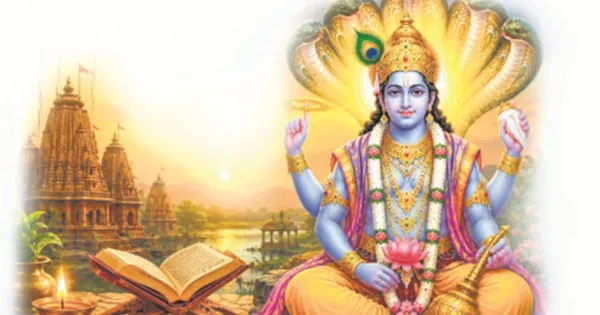
According to religious texts, Purushottam month comes once in three years. It is also called Adhik Maas. First of all, let us know that according to astrology, the month in which there is no Sankranti between Amavasya and Amavasya is called Adhik Maas. Sankranti means change in the zodiac sign of the Sun. The entry of Sun from one zodiac sign to another is called Sankranti. According to astrological calculations, a solar year is considered to be of 365 days, 6 hours and 11 minutes and a lunar year is considered to be of 354 days and 9 hours. Adhik Maas came into existence to equalize the calculations of solar year and lunar year.
‘Malamas’ is the Adhik month that comes every three years according to the Hindu calendar. According to the English calendar, there are 12 months, but do you know that according to Hindu belief, one year in every three years is of 13 months? You may not believe it, but it is true. Let us tell you the truth related to this. The thirteenth month that comes every third year is called Malamas. There is no mention of this month in English, but according to the belief of Hindus, there is a month of Malmas, it is also called Purushottam month.
The story of Malmas falling in Purushottam month is also interesting. Malmas went to Lord Vishnu in Kshir Sagar and prayed that Lord, if I am so bad, then why did you create me? Because every constellation, every day, every planet has some owner, but because I do not have any owner, no one does any auspicious work in this month. Then God gave a boon that from today onwards you will be known by my name i.e. by the name of Purushottam and those who worship me in this month will receive innumerable virtues and will be free from the ocean of existence.
Worship has special significance in Purushottam month. The person who fasts, worships and does charity with full devotion and faith. He attains virtue and gets freedom from suffering. According to the scriptures, at the beginning of the month, Lord Vishnu should be worshiped with red sandalwood, red flowers and Akshat. Sweet puvas made from ghee, jaggery and wheat flour should be donated to God by offering them fruits and flowers along with Dakshina clothes in a bronze vessel.
According to religious texts, auspicious works are prohibited in Adhik Maas. Like naming ceremony, house warming, sacred thread ceremony, mundan, marriage, entry of new bride, buying a car, foundation worship etc. In this month, one should also avoid Tamasic food like meat, alcohol, garlic, onion etc. The activities to be performed in this month are annual Shraddha, Rudrabhishek, Garbhdhan Sanskar, donation, chanting, Punsavan Sanskar and Seemantonnayan Sanskar can be done to get relief from the sufferings like death. Land in Purushottam month
But one should sleep and eat simple and wholesome food.
Bhagwat Purana has 15 chapters in 6 cantos. The story of Hiranyakashipu comes in the first five chapters. Once he did severe penance from Lord Brahma and asked for a boon from him that he should not die in any month of the creation created by him, neither should he die above nor below, nor should he die outside, nor inside. Brahma ji became happy and said Amen. In order to kill the same Hiranyakashipu and to protect the devotee Prahlad, he took the incarnation of Narasimha and destroyed the unrighteousness by killing the evil one in this month itself.
According to the mythological Indian text Vayu Purana, ‘Vajpayee Yagya’ was performed by Magadha emperor Basu in Rajgir, Bihar. In that Yagya, all the Gods and Goddesses including Raja Basu’s grandfather Brahma had come to Rajgir. Water from holy rivers and places of pilgrimage was required for the yagya. It is said that on the call of Brahma, the water of various pilgrimages had appeared from the fire pit. The fire pit of that Yagya is today’s Brahmakund (Rajgir, Bihar). A large number of sages and maharishis also came to that yagya.
A grand fair is also organized in Rajgir on this occasion.
In this month, lakhs of devotees, apart from the holy rivers Prachi, Saraswati and Vaitarani, take bath in the hot water ponds, Brahmakund, Saptdhara, Nyaskund, Markandeya Kund, Ganga-Yamuna Kund, Kashidhara Kund, Anantrishi Kund, Surya-Kund, Ram-Lakshman Kund, Sita Kund, Gauri Kund and Nanak Kund and worship in the Lord Lakshmi Narayan temple. Hot water continuously falls in these ponds throughout the year. The source of this water is still unknown.
In Purushottam month, the best month, there is glory of attaining Artha, Dharma, Kama and Moksha. Legend has it that King Hiranyakashipu had sought a boon from Lord Brahma that he should not die during the night, day, morning and evening and in any of the twelve months created by him. After giving this boon, when Brahma realized his mistake, he went to Lord Vishnu. Lord Vishnu, after thinking, created the thirteenth month for the end of Hiranyakshipu. There is a religious belief that this additional month is called Malmas or Adhik Maas.