
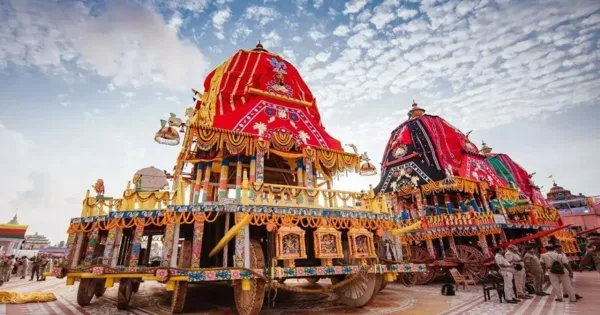
The Rath Yatra of Jagannath Swami held in Puri on Ashadha Shukla Dwitiya is one of the biggest religious festivals not only in South India but across the country. The amazing splendor of faith that is seen in this Rath Yatra festival has no match. Such a huge folk festival is not organized anywhere else in the world. That is why this Rath Yatra has remained the center of attraction not only for Indian but also foreign tourists for centuries.
Every year lakhs of devotees participate in this Rath Yatra with full faith. This Rath Yatra is such a unique community festival of the Sanatani devotees of the country and the world, in which the Lord Jagannath Mahaprabhu himself comes out of the temple along with his brothers and sisters to meet the devotees and with his blessings blesses everyone and gives the message that everyone is equal in the eyes of God, no one is small or big, no one is rich or poor.
In Skanda Purana, Jagannathpuri is also known as Nilanchal Dham, Shri Kshetra, Purushottam Kshetra and Shankha Kshetra, the lord of this divine pilgrimage city has been called Paratpar Param Brahm. Calling Jagannath Puri as ‘Baikuntha’ of the earth, scientists say that the person who joins this Rath Yatra and goes to the Gundicha temple chanting the kirtan of Lord Jagannath and who gets the privilege of pulling these chariots, becomes free from the cycle of rebirth.
mythological story
According to the mythological story described in Brahma Purana, in Satyayuga, in Avanti city of South India, there was Chakravarti Emperor, a great devotee of Lord Vishnu named Indradyumna. Once after performing Ashwamedha Yagya, he started thinking as to what solution should I take so that I can see the best form of my deity. The king, immersed in worry, was instructed in his dream at night that there is a liquorice tree on the sea coast of Utkal province, cut it and bring it, make a deity from that wood and install it in the temple. The king brought wood from the appointed place, but became sad as he could not find any competent artisan to build the idol. Then by divine chance, Devshili Vishwakarma went to him in the guise of an old craftsman and agreed to make a conditional idol. The condition was that the king would maintain complete secrecy of this construction work for 21 days. The construction of the idol begins, but Queen Gundicha, wife of King Indradyumna, is unable to control her curiosity and goes secretly on the 15th day to watch the construction of the idol, but as soon as this happens, the craftsmen disappear leaving the idol incomplete. Queen Gundicha deeply regrets this mistake and apologizes to the king. Only then does the voice from the sky say that only these incomplete idols should be installed in the temple. Then King Indradyumna built a grand temple and pleased Prajapati Brahma by doing penance and got the incomplete wooden idols of Lord Jagannath, Balabhadra and Subhadra consecrated in the temple. From then till today, only these wooden idols without bottom are worshiped in Jagannath Puri.
Unique preparations for Rath Yatra
Preparations for the ten-day Rath Yatra festival begin with the ‘Vanajaga’ festival on the day of Akshaya Tritiya. The work of picking wood starts before Vasant Panchami. The construction work of the chariots, which lasts for two months, begins with a religious ritual. These chariots, made from the wood of the Daru tree, do not have any metal nails or thorns. These chariots are made by traditional artisans from generation to generation. The size, number of chariots and how much wood will be used in each chariot, all this is decided in advance. Jagannath’s 45 feet high chariot ‘Nandighosh’ has 16 wheels, Balabhadra ji’s 44 feet high chariot ‘Taladhwaj’ has 14 wheels and Subhadra’s 43 feet high chariot ‘Devdalan’ has 12 wheels. 1090 meters of cloth is used to decorate these chariots.
Jagannath’s chariot is covered with red and yellow clothes, Balabhadra’s chariot with blue clothes and Subhadra’s chariot with black clothes. The rope that pulls these chariots is called ‘Swarnachuda’. These chariots are brought to ‘Singhdwar’ before the start of the Rath Yatra on Ashadh Shukla Dwitiya. The deities are bathed, adorned with new clothes and ornaments and placed in chariots after offering food. It is called ‘Pahondri Festival’. Before the chariots start moving, the king of Puri comes in a palanquin and worships these deities. This is called ‘Chhar Pahanra’. After the puja, the journey begins with melodious devotional songs amid the sound of drums, trumpets and conch shells. These three brothers and sisters come out of the temple and go among the devotees riding on their respective huge chariots. This journey from Jagannath temple to Gundicha temple and then back to Jagannath temple is completed on Ekadashi date.
Maha Prabhu’s amazing kitchen
Jagannathji’s kitchen is the most unique kitchen in the world, whose food never runs out. The food given to the devotees on the occasion of Rath Yatra is called ‘Mahaprasad’. In this unique kitchen, the entire food offering is prepared in earthen pots on stoves. To make Prasad, seven vessels made of wood are placed one above the other on the wooden stove. In this process, the ingredients in the top vessel are cooked first, then one by one towards the bottom. Four hundred cooks prepare food here. The Mahaprasad of Rath Yatra consists of dishes like arhar dal, rice, greens, curd and kheer, a part of which is offered to the Lord and then placed on Kadli leaves and served to the devotees. Around 25,000 devotees receive Prasad from this kitchen every day, while this number reaches lakhs during the Rath Yatra. Another most important thing about this kitchen is that there is no caste discrimination here. Brahmins and lower caste people eat together.
Poonam Negi, Lucknow
Rath Utsav or Shri Gundicha Yatra
Rath Yatra, also known as Rath Utsav or Sri Gundicha Yatra, is held annually near the Lord Jagannath Temple located in the ancient city of Puri in Odisha. Every year, lakhs of devotees from all over the world join this grand procession dedicated to Lord Jagannath. The Rath Yatra symbolizes the journey of Lord Jagannath along with his siblings Lord Balarama and Subhadra Devi from his temple to the Gundicha temple.
The world famous Puri Jagannath Rath Yatra usually lasts for 9 days. It begins on the second day of Shukla Paksha of Ashadha month and concludes with ‘Bahuda Yatra’ (return journey) on the ninth day. During this, Lord Jagannath, Balabhadra and Goddess Subhadra move from the main temple to Gundicha temple and rest there for 7 days.
Three chariots are constructed every year, and thousands of devotees move around on grand wooden chariots pulled by ropes. Each god has his own unique chariot. The chariot of Lord Jagannath is called Nandighosh, that of Lord Baldev is called Taladhwaj and the chariot of Goddess Subhadra is called Darpadalan. Path to attain salvation: According to the Puranas (like Skanda Purana), just by seeing the chariot or by pulling the ropes of the chariot, the sins of many births are washed away and one attains salvation. It is a symbol of selfless Karmayoga.
Divine Accessibility: Usually the deity sits in the sanctum sanctorum of the temple, but during this yatra the god himself comes out to give darshan to his devotees. Mythological belief: This festival commemorates Lord Krishna’s visit to Vrindavan. Gundicha Temple is considered to be the birthplace of the Lord or ‘Aunty’s House’. Social Importance: Rath Yatra is the biggest example of social equality, cutting across castes and castes. All the devotees participating in it, irrespective of caste or class, come together without any discrimination to pull the huge ropes of the chariot.
Pt. Manoj Kumar Dwivedi Spiritual Writer, Astrologer
all inclusive Culture: : it Festival humanity And brotherhood Of Message gives Is, Where All Devotee God Of the court In One Similar would have been Are