
Ashok Suri…: Since ancient times, India is not only an agricultural country, but at the same time India is also a festival oriented country. India is a country of diverse cultures, where every season brings with it a new excitement and enthusiasm. In India, most of the festivals are celebrated during the preparation of one or the other crop, the reason for this is not only the period of the festival, but also sufficient amount of resources and money is available with the families to spend on the festival. The festival of Holi arrives as soon as the wheat crop is ready and the festival of Diwali arrives as the preparations for Kharif begin. Although the Rabi crop is ready early in Punjab, the wheat is completely harvested and reaches the farmers’ homes by the end of Chaitra and their earnings start coming home. Baisakhi, the main festival of Punjab, is associated with this season.
Jatta Aai Baisakhi
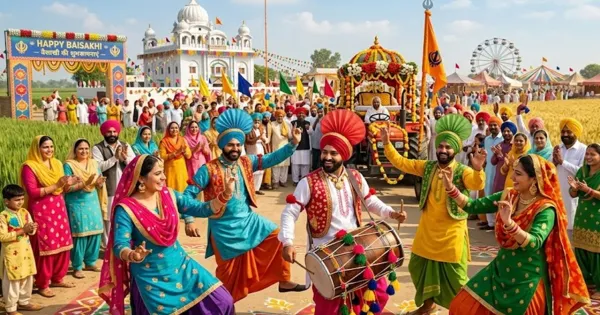
When a farmer in Punjab sees the golden ears of his wheat crop blossoming, his heart is filled with joy, and then Punjabis need a chance to celebrate. With the announcement of ‘Jatta Aayi Baisakhi’, every Punjabi’s feet start dancing to the beats of Dhol and the lyrics of Bhangra and Gidda, which is a living portrayal of the happiness of this festival. Baisakhi festival infuses new energy into the rural and urban economy. In Punjab and Haryana, this festival is not just a date, but is a celebration of the fruits of the farmer’s hard work and the rebirth of faith. From religious point of view, the day of Baisakhi is celebrated every year on 13 or 14 April. This day also marks the first Sankranti of the Hindu New Year, and the Sun enters Aries. But the day of Baisakhi in Punjab is recorded in golden letters in Indian history. On this day in 1699, the tenth Guru of the Sikhs, Sri Guru Gobind Ji, established the Khalsa Panth in Anandpur Sahib.
Sikhs celebrate this day as ‘Sajna’ day. On this day, Shri Guru Gobind Singh Ji sprinkled nectar on the Panch Pyaras by erasing the discrimination of high and low and gave birth to a brave community to fight against injustice, which Guru Ji named ‘Khalsa’ and with this he gave the immortal message of ‘Raj Karega Khalsa’. On this day, Dashmesh father Guru Gobind Singh ji established the Khalsa sect. Today’s Sikh community is an expanded form of this Khalsa sect. Guru ji sprinkled nectar on the five beloveds and gave them the title of five beloveds and the immortal formula. On this occasion, Guru Gobind Singh Ji himself proved that there is no difference between Guru and disciple by drinking nectar from the five beloveds. He had said – ‘Ape Guru Chela’ meaning he himself is the Guru and also the disciple. Guru Gobind Singh Ji was the tenth and last Guru in human form of the sect. After this, Guru Granth Sahib itself was kept on the title of Guru.
Wahe Guru Ji’s Khalsa Wahe Guru Ji’s victory
It means that this Khalsa sect belongs to Wahe Guru Ji, hence its victory is always certain. Guru Ji gave a special identity to all Khalsa followers, which was called five Kakar (Kada, Kirpan, Kachhaira, Kangha and Kesh). Even today, people of Sikh sect follow these five orders of Guru Ji. Guru ji described all Sikhs as lions and ordered them to put lion before their names and women to use kaura. This order became a symbol of equality and harmony in the sect. Today, in the city kirtan organized on the occasion of Sikh festivals, Panj Pyare wearing saffron robes walks at the front. Today, Kirtan, Ardas and Langar are organized regularly in every Gurudwara. The folk culture of Punjab is at its peak on this day. Young men and women dancing to the beat of the drum, colorful clothes and an atmosphere full of enthusiasm attracts everyone.
Inspiration of hope and new consciousness
Apart from Baisakhi, this day of 13th April is also special for some other events in Indian history. On this day Gautam Buddha attained Nirvana. On this day Swami Dayanand Saraswati founded Arya Samaj. The festival of Baisakhi teaches us to be loyal towards our duties and also gives the message of unity, brotherhood and humanity. In Guru’s langar no one is big or small, everyone serves the Guru’s prasad in the same line. In today’s time when society is facing many challenges. The festival of Baisakhi inspires us with positivity, hope and new consciousness.