
If we take a look at our mythological history, then the name of Karna comes before us as the biggest donor – whoever asked from Karna, he donated it to him, but here we see that Karna always donated money only, but that warrior who was almighty, knowledgeable about religion, who donated even his head, such an unprecedented supreme warrior – there is only one and only one barbarian. Barbarik was also born during the period of Karna and along with Karna, he also became invisible in the Mahabharata war.-Ashok Suri
Mention in Skanda Purana
Barbarika, son of Kunti, was the grandson of the mighty Bhima and the son of the very powerful and elusive Ghatotkacha. His mother’s name was Nagkanya Ahilavati (somewhere Morvi). There are some characters in the Indian mythological tradition, who appear very limited in the texts, but assume a huge form in the folk tales. Barbarik is one such name, who became immortal in history without picking up any weapon in the Mahabharata war. Later, this brave Barbarik became the center of public faith in the form of Khatu Shyam and started being worshiped in every home. The story of Barbarik is mainly found in the Kaumarika and Reva sections of Skanda Purana, but even here the name Barbarik is not mentioned. In the currently available Avanti Khand/Reva Khand of Skanda Purana, there is an indication of the story of Shyam/Shyamdev, who has been given the boon of being worshiped in Kaliyuga by Lord Shri Krishna and has approved Sheeshdaan.
The following verse is mentioned in the popular Skanda Purana.
Devdevesh Grihaan Purushottam in Shisham. Yudh Darshanmichhami Tav Prasadaanmahamune. That means, oh great man, please accept this head of mine and by your grace I want to become a witness to this great war. Apart from this, another verse comes that Kalau Tvam Shyamnama Pujyaah Sarvajana Priyaah. Bhavishyasi gives fruitful results to great devotees. That is, in Kaliyuga, you will be worshiped by the name Shyam and you will be loved by everyone and will provide desired results to the devotees. In the past, you were known by the name of Shyam and you were also worshiped with this name.
Silent witness of Mahabharata
According to mythology, Barbarik was a wonderful hero, who performed severe penance for the Goddess. Pleased with his penance, the goddess prayed to Lord Shiva to grant a boon to Barbarik. Lord Shiva provided three infallible arrows to Barbarika. These were not ordinary arrows, but divine and conscious weapons, which could themselves differentiate between enemy and friend on the battlefield. Due to these arrows, Barbarik became the master of immense power and became famous as a great warrior. Barbarik’s specialty was not only his power, but also his judicious control over that power. When his mother came to know about the amazing power of her son, she made him take only one promise – that he would use these arrows only to protect the helpless and weak society. He also told his son that he would always have to support the losing side in the war. Barbarik followed this order and promise of his mother throughout his life. For this reason he was called “the support of the loser”.
After the death of Ghatotkacha, Barbarik asked for permission to go to war. While bidding farewell, the mother again reminded him of his promise. At that time in the Mahabharata war, the position of the Kauravas was weak and they were close to defeat. As per his vow, Barbarik decided to fight in favor of the Kauravas. But this situation was fatal for the balance of religion. Lord Shri Krishna, who was on the side of Pandavas, understood very well the power of Barbarika and his promise. He asked Barbarik the reason for coming to war. Barbarik clarified that he always supports the loser. This sentiment was born out of compassion, but could have been destructive from the religious point of view.
Shri Krishna tested Barbarik’s strength, in which he was completely successful. Then God had to take a harsh and unpleasant decision. In the guise of a Brahmin, he asked for donation of a head from Barbarik. The great donor Barbarik accepted the donation, but first expressed his desire to see the real form of God. After seeing Shri Krishna, Barbarik said that now there is no purpose left in life. He had only one wish – to see the war till the end. As soon as God said “Evamastu” Barbarik offered his head. Shri Krishna installed that mirror on a high mound, from where he could see the entire war. As a result of this great sacrifice, God blessed him that in Kaliyuga he would be worshiped by his own name “Shyam”. This Shyam later became famous as Khatu Shyam.
Major Dham in Sikar, Rajasthan
Khatu, located in Sikar district of Rajasthan, is his main abode – where Shyam is not just a mythological memory, but a living deity of folk faith. It is popular in folk tales that the head of Barbarik had appeared in Khatu. The specialty of Khatu Shyam is that here Shyam is not worshiped as a king but as a servant, whereas in Dwarka he is worshiped as Dwarkadhish. Khatu Shyam is not a god who wins the war, but is a deity who helps in times of crisis. According to folk tales, Narmada Kanwar, wife of Raja Roop Singh of Khatu, had a vision of the appearance of God’s head in her dream, after which Raja Roop Singh Chauhan built the first temple at this place in 1027 AD. After this, in 1727, Diwan of Marwar Abhay Singh got the temple renovated grandly.
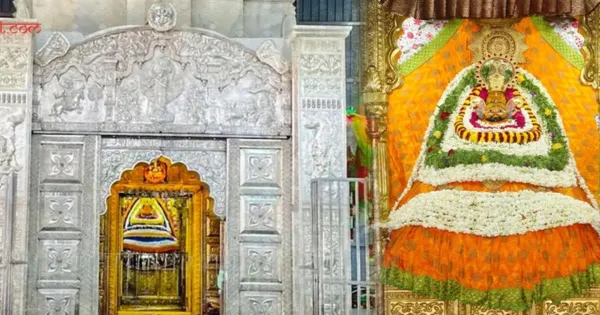
The famous white marble of Makrana has been used in the construction of the temple and the layers of the doors of the sanctum sanctorum have been plated with silver. Shyam Kund is situated near the temple, where the sacred head of Baba had appeared. Shyam Baba is worshiped with scent, flowers, incense, lamps and offerings. Specially Churma, Mishri Mawa, Kheer or Peda are offered to Baba. The flag is mainly offered to Baba as a symbol of victory. Devotees receive blessings from Morchhadi. From 21st February to 28th February, Phalgun Lakhi Fair full of reverence, devotion and gaiety will be organized at Khatushyam Ji Temple.