
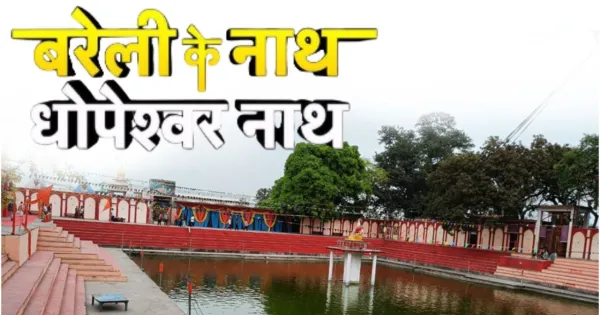
Among the few ancient pilgrimage sites that form the spiritual identity of Bareilly, the place of Dhopeshwar Nath Temple is very special, ancient and full of reverence. It is not just a Shiva temple, but a living center of time, practice, folk faith, history and cultural continuity. As soon as one enters the courtyard of this temple, one feels as if the worship of many centuries is still pulsating in the atmosphere.
The sound of the temple bells, the continuous flow of water on the Shivalinga, the aroma of incense, the shade of ancient trees and the silent prayers of the devotees give this place a unique divinity. Dhopeshwar Nath is not just a place of worship, but a spiritual center residing in the soul of Bareilly, where generations have been devoting their hope, faith and emotions.
part of panchal landmass
According to local traditions and legends, the mythological roots of this temple are believed to be linked to the ancient Panchal kingdom. This entire area is considered to be a part of the Panchal region during the Mahabharata period, where King Drupada ruled and from where the glorious history of his daughter Draupadi is connected. It is a popular belief that during the struggling times of her life, Draupadi had worshiped Lord Shiva at the Shiva places located in this area and by offering water, flowers and reverence to Dhopeshwar Nath, prayed for strength, protection and justice for her life.
This story has become not only a religious sentiment, but also a symbol of women’s power, patience and inner strength. Even today, many women come here and feel that like Draupadi, the prayers here strengthen their life. Dhopeshwar Nath, in this view, becomes the place where Shiva becomes not just a deity, but a compassionate witness to the suffering.
Nath tradition
Some archaeological signs found locally also confirm the antiquity of the temple. From time to time, local people have been talking about finding ancient stone blocks, remains of old sculptures and figures engraved on stone in and around the temple complex. The style of these remains indicate that this area may have been part of an ancient temple complex or spiritual structure. Although extensive scientific excavation in this area is limited, yet these archaeological signs preserved in local memories show that the worship of Dhopeshwar Nath is not just a few generations old, but has crossed many periods of time and has reached the present.
The importance of Dhopeshwar Nath is not only mythological but also very special because of the Nath tradition. Bareilly region has long been considered the land of meditation, yoga and penance. According to local beliefs, saints like Dhumra Rishi performed penance here and later their disciples developed this area as a meditation centre. Where today R. N. The area where Tagore Inter College is situated is also once considered to be the holy place of sages. It is said that there were ashrams here, where students from far and wide came to receive education and discipline. This wonderful confluence of spiritual practice and education makes this area important not only from religious but also from cultural point of view.
Baba Hardev Pond
Baba Harihar Dev is mentioned with special reverence in local tradition. It is said that he carried forward the tradition of his Guru and created a vast spiritual environment here. A pond was built for the students, around which 108 Peepal trees were planted. This pond is still alive in memories as Baba Hardev Pond. Trees of mango, guava, jackfruit, jamun, fig, banana etc. were planted around it, making this area a beautiful confluence of nature and spirituality. This shows that not only worship took place here, but there were also arrangements to make life balanced, disciplined and self-reliant.- CEO, Cantonment Board, Bareilly
story related to temple
There is also a very emotional story of Kedar Nath Tandon related to Dhopeshwar Nath temple, which is still narrated with reverence among the devotees. He was an ordinary accountant, who used to come to the temple every day and present his life’s difficulties before Lord Shiva. One day a saint blessed him that his devotion would soon lift him from ordinary life to a higher level of prosperity. After some time, he got an opportunity to go to Assam and start a business. There he was extremely successful, but even amidst prosperity, his mind remained attached to Dhopeshwar Nath. Every Shravan month, he would come to Bareilly to have darshan, give donations, organize Bhandara and finally in Assam too, he established a Shivalinga in the name of Dhopeshwar Nath and built a temple. This story still venerates this temple as a “life-changing blessing”.
Nath Nagari Corridor
At present Dhopeshwar Nath Temple is one of the most active spiritual centers of Bareilly. A huge crowd gathers here during Mahashivratri and Shravan month. Devotees bring Ganga water from far and wide. The echo of “Har Har Mahadev”, Shiva praise, Rudrabhishek and flow of devotion in the temple premises makes the atmosphere extremely divine. Many families come here for generations and involve their children in this tradition. The importance of the temple has increased further in recent years, because under the leadership of Yogi Adityanath, efforts have been made to link many ancient religious places in Uttar Pradesh with overall development. In this sequence, the concept of Nath Nagri Corridor has emerged as very important for Bareilly. The objective of this corridor is not only to provide access to the temple but also to connect the major sites, temples, ancient ponds, routes and cultural points associated with the Nath tradition into an overall spiritual stream. Dhopeshwar Nath Temple is considered to be a special place under the Nath Nagari Corridor because it is the central place of the ancient Shiva tradition of Bareilly. If this project is fully developed, many works like beautification of the temple area, traditional style lighting, pilgrim facilities, heritage-oriented routes, cultural information boards and environmental protection will be possible. This will further strengthen the spiritual identity of Bareilly at the national level.
temple of living faith
At present, sensitivity towards this area has also increased from the local administrative point of view. The vision of Dr. Tanu Jain, Chief Executive Officer, Bareilly Cantonment to develop the surrounding cultural and heritage-related sites with dignity and cleanliness connects to this broader heritage consciousness. It is extremely important to understand that the sanctity of a temple is not limited to its sanctum sanctorum only, its surrounding environment, cleanliness, greenery and public dignity also deepen its spiritual experience.
Dhopeshwar Nath Temple today is not just a memory of the past, but a living faith of the present and the cultural direction of the future. Here is the imagination of Draupadi’s silent prayer, the penance of the sages, the meditation of the Nath saints, the changed destiny of ordinary devotees, the silent testimony of ancient idols and the possibility of a new spiritual restoration of modern times. When a devotee stands in front of the Shivalinga and offers water, he does not just worship – he connects himself with the centuries-old faith that has been flowing here for generations. This is the biggest power of Dhopeshwar Nath. This temple is not just a temple of stones, but of living faith