
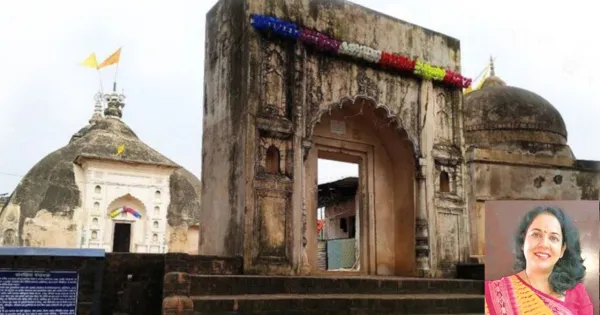
Generally faith and science are considered to be the two ends of human life. Divine faith is the greatest strength of the Indians and various miraculous temples of the country nourish and strengthen this faith. One such miraculous temple of the country is Jagannath Temple. This thousands of years old ancient temple of Jagannath Temple, located in Behta Buzurg village of Kanpur district of Uttar Pradesh, is such a unique center of Indian archeology and folk faith, which has been challenging modern science for centuries. Even in this technological age, this temple of Lord Jagannath is famous by the name of ‘Monsoon Temple’ in the entire district because of giving accurate information about rain through water drops.
Living proof of deep meteorological knowledge
This temple of Lord Jagannath, full of mysteries, is not only a center of religious faith but also a living testimony of the profound knowledge of weather of ancient Indian sages and architects. Even meteorologists are surprised to see the miracles of this temple which accurately predicts the monsoon. According to the current priest of the temple, Kudha Prasad Shukla, about a week before the monsoon, drops of water start falling from the dome of the temple directly on the idol of Lord Jagannath. If the idol of the God is slightly moist, it is a sign of less rainfall that year.
If light water droplets are visible on the statue, it is a sign of normal rain. But if the idol appears completely wet due to the water drops dripping from the dome, it is a sign of good rainfall in the area that year. This Jagannath temple of Behta old age tells us that our ancient Sanatan culture and science are not opposed to each other, but complementary. This temple is a symbol of the rich heritage of India, where the mysteries of nature were combined with spirituality and used for public welfare.
monsoon predictions
It is interesting to know that the Meteorological Department has also considered these predictions of the temple to be correct. For this reason, many scientists from across the country have come here to know this mystery. According to Sunil Pandey, meteorologist of Chandrashekhar Azad University of Agriculture and Technology, who has inspected this temple twice, droplets are formed due to accumulation of moisture in the stone, which devotees consider to be a sign of monsoon, but till date it has not been found out why these droplets are formed only in this temple. What is the real reason behind this, this mystery has not been solved till date.
Many geologists and archaeologists have tried to solve this mystery. Some experts believe that the stones used in the construction of the temple may have ‘hygroscopic’ properties, which sense the moisture level in the air and convert it into water. However, the creation of such ‘weather forecasting’ technology thousands of years ago without any modern equipment is still a subject of research. Witness the miracle.
village elders
On one hand, scientists are busy understanding this mystery of the temple from their perspective, while on the other hand, for the villagers, all this is the glory of God. Similarly, Malti Devi of the village tells that seeing drops of water on the idol of God in the midst of scorching heat seems like a mystery. Not only him, his ancestors also used to predict monsoon on the basis of these water points, which was always accurate. Even today, local farmers plan the sowing and harvesting of crops after seeing the drops of this temple. The elders of the village say that this tradition has been going on for generations.
The ancient temple is important from archaeological point of view
The circular dome of this temple, which is about four thousand years old, 14 feet thick walls and the huge structure standing on 12 pillars makes it very important from historical and archaeological point of view. Its architecture is similar to the Buddhist Stupa of Sanchi. Although there are differences of opinion among historians regarding the period of its construction, but its style dates it from the Maurya period to the Gupta period. Sculptures of Dashavatars of Lord Vishnu are carved outside the temple, which reflects its eternal roots. Rare statues of Lord Jagannath, Balabhadra and Subhadra made of black stone are present in the sanctum sanctorum of the temple. The half sun symbol is still present in this mythological temple. In ancient times, Suryavanshi kings used to wear Ardha Surya Tilak on their forehead. The finding of half sun symbol in the excavation of Ram Janmabhoomi temple also proves the mythology of this temple. Ram Kund pond located in the temple complex is believed to be of Tretayuga.
Legend has it that Lord Shri Ram came here after conquering Lanka and performed Pind Daan of his father King Dasharatha. He says that every year on the lines of Jagannathpuri, a grand Kalash Yatra is organized here in the month of Ashadh, in which a large number of devotees of the area participate. Temple’s chief priest K.P. According to Shukla, this temple is believed to be built in the 11th century. Later, the temple was renovated by a landlord of the area. According to him, archaeological excavations have found remains from the Indus Valley Civilization to the Maurya period in the temple complex. The temple committee has demanded their conservation from the state government and the archeology department.
Poonam Negi, Lucknow