
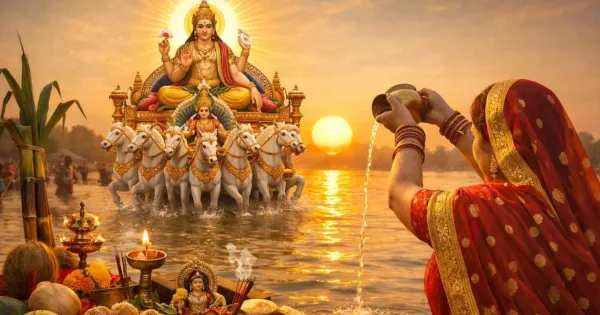
There are five visible gods in Kalyug, whom we can see with our eyes – Surya, Moon, Ganga, Yamuna and Govardhan Mountain. Among these, Sun is the most prominent. Sun is Sun, Sun is the king of all the planets. Sun is eternal, Sun is the soul, the entire creation is dependent on Sun. Sun has the zodiac sign Leo. In this zodiac sign neither any planet is exalted nor any planet is debilitated. Leo is the house of Sun. Sun is the most disciplined planet. Never lets anyone go astray. It will rise on time and set only at a fixed time. The Sun moves from north to south for six months and from south to north for six months, which is called Uttaraayani of the Sun. – Ashok Suri, spiritual writer.
The change in the zodiac sign of the Sun is called Sankranti.
Sun is an ever-moving planet, its seven horses never rest. According to astrology, there are 12 zodiac signs and the Sun moves in each zodiac sign for about 1 month. The change of Sun from one zodiac sign to another is called Sankranti. In all the zodiac signs, the Sun changes between 12th and 17th of the English calendar. The Sun travels through each zodiac sign every 24 hours, but always enters Capricorn on January 14 (sometimes January 15). The entry of Sun planet into Capricorn is celebrated as Makar Sankranti. The lord of Capricorn is Saturn. Before this, the Sun moves into Jupiter’s zodiac sign Sagittarius, which is called Kharmas. Doing any auspicious work during Kharmas is prohibited. As soon as the Sun enters Capricorn, the bonds of Kharmas end and the auspicious festival of Makar Sankranti begins. This day is a sign of the Sun becoming Uttarani. On Makar Sankranti, there is a tradition of bathing, donating and offering prayers to the Sun. From Kharmas and Makar Sankranti we learn that restraint and celebration are necessary at their respective times in life.
Different forms of Sankranti
According to mythology, on this day Sun God visits the house of his son Shani (Capricorn), which is also a symbol of the relationship between father and son. Bhishma Pitamah left his body on this day. It is a belief of Hindu religion that one attains salvation by leaving the body at the time of Uttarayani Surya. The incarnation of Gangaji on earth and the offering of prayers to his ancestors by Bhagiratha also took place on this day. This festival is celebrated in different forms in different provinces of India. While in North India Ganga bath and Khichdi are important, in South India it is celebrated as Pongal. Celebrated as kite festival in Western India. In the eastern states it is celebrated as Bihu, in which community harmony and feasts are organized. The Ganga Sagar fair celebrated once a year in Bengal is also held on this day. It is said… “All the pilgrimages again and again, Ganga Sagar once”. In Punjab, the festival of Lohri is celebrated a day before Makar Sankranti. Eating and distributing sesame and jaggery has special significance in this festival also. Makar Sankranti is also a festival of charity – donating sesame, jaggery, warm clothes, khichdi, cow donation etc. on this day is believed to reduce sins and increase happiness and prosperity.
message of positivity
The festival of Makar Sankranti gives us the message of “eat jaggery and sesame seeds and speak sweetly” to the society. This festival coming at the beginning of the year “Sarve Bhavantu Sukhinaah” – wishes a beautiful life for everyone. This festival connects us socially and strengthens the spirit of mutual cooperation. After Makar Sankranti, time gradually moves towards auspiciousness. After this festival, changes in weather also begin – winter season returns and spring season begins to arrive. As the Sun moves north, the days start getting longer and the nights start getting shorter. The festival of Makar Sankranti teaches us that just as the Sun increases its light by becoming Uttarayan, similarly we should increase positivity in our lives.