
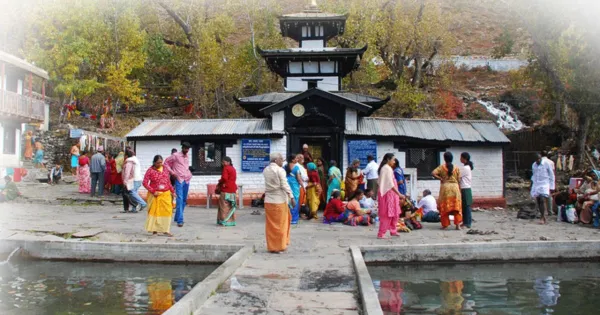
Mustang district of Nepal is in the headlines these days mainly for two reasons. One, the availability of precious metals including uranium in large parts of the long and high mountains here and second, Muktinath Dham, the center of faith of the Hindu and Buddhist communities. There is a competition between India, China and America to acquire the part of the mountain where precious metals are available, while thousands of devotees of India are striving to get salvation by having darshan in Muktinath Dham and bathing in the sacred water stream originating from Gandaki river.
The height of Mukti Nath Dham is around four thousand meters above sea level. Local people call Muktinath temple the door of salvation. Rain is common in the mountains, even in the hottest summer months the water here is like ice and the cold is like December and January.
Wherever our places of worship are located on the mountains, obviously the roads there are inaccessible and scary. The land of Nepal is Deodhara from the point of view of Hindu religion. The temple of Baba Pashupatinath in Kathmandu is at the simplest place. Where it can be easily reached without causing any pain to the body, while whether it is Supa Deurali, Manokamna Temple or Muktinath Temple, reaching here is a challenge, yet devotees do not fail to register their presence here. It is estimated that more than 125 Indian devotees are reaching Muktinath temple every day. That too when there is a risk of oxygen along with severe cold.
Mustang District, located on the Tibet (China) international border northwest of Kathmandu, was an independent royal kingdom. The kingdom became subject to Nepal in the late 18th century, but the Gorkha kings of Nepal allowed Mustang to retain its autonomy. The last king of Mustang was Jigme Dorje Palabar Bista. The monarchy of Mustang was officially abolished after the liberation of Nepal in 2008.
Korla Pass, located on the summit of Mustang, is the international border that connects Nepal to the border of China (Tibet). The distance from Kathmandu to Mustang is about four hundred and fifty kilometers. Indian pilgrims can go through any authorized border of India Nepal border. Pokhara is a junction from where the route to Jomsom Muktinath Temple goes. Devotees from Nepal also have to reach there through this route. It takes 18-20 hours by road to reach Muktinath from Nepal border with Uttar Pradesh.
Obviously, such a long continuous journey by road is difficult, hence the devotees have to take a night’s rest in Pokhara. Both while coming and while going. There are also domestic flights to Jomsom from Kathmandu and Pokhara. Taxis and minibuses are always available from Pokhara to Jomsom. It takes about 12 hours from Pokhara to Jomsom. It takes one and a half to two hours to reach the Ves of Rani Powa Mukti Nath Temple from Jom Som. From here one has to walk one and a half kilometer to reach the temple. Generally people take a night rest in Jomsom before going to Muktinath temple and this is good.
The special thing is that just as a special permit is required to reach Nathula Pass from Gangtok, similarly it is mandatory to obtain Annapurna Conservation Area Project (ACAP) permit to reach Muktinath Temple from Jomsom. Without this permit further travel is not possible. If you are staying in a hotel, most of the hotel managements help you in getting this permit through Nepal Tourism Board. This saves your time and also gives relief from unnecessary running around. Whereas if you are traveling in your personal vehicle, then you have to complete the entire process yourself, which includes formalities like visiting the concerned offices and submitting the necessary documents.
My personal experience says that if you are traveling in a group of four, six or more people, hiring a local Nepal taxi is a more convenient and practical option. This not only makes the journey comfortable, but also eliminates the need to worry about police check-posts, permit checks and other administrative formalities. The taxi driver himself takes care of all these processes.
It is also special for Buddhists
Muktinath Temple is not only a center of faith for Hindus, it is also special for Buddhists. According to Buddhist religious leaders, Guru Rinpoche, the founder of Tibetan Buddhism, meditated here while visiting Tibet in the 12th century and attained enlightenment here. No one knows the exact details of the antiquity of this temple situated on the remote mountains, but this temple, built in pagoda style, is said to have been constructed in 1815 AD. According to local priests, the temple was built by Suvarna Prabha, wife of the then King of Nepal, Rana Bahadur Shah. There are 108 Gomukhs in the main complex of the temple, in which the water streams of the holy Gandaki river keep flowing continuously. Legend has it that by bathing in these streams, devotees’ sins are washed away and they attain salvation. There is a small temple just behind the temple, from where water miraculously leaks and flames come out. In Hindu beliefs it is called Jwala Devi. Buddhists consider it a wonderful confluence of fire, water and earth.
What is the importance of Muktinath temple?
According to Hindu religion followers, Lord Vishnu was freed from the curse of Jalandhar’s wife Vrinda here. This is said to be the reason behind naming this temple Muktinath. It is mentioned in Bhagwat Purana that this place is one of the 108 Shakti Peethas. It is believed that the head of Mata Sati had fallen at this place. The Kali Gandaki river located near the temple is said to be the origin of Shaligram. Shaligram is considered to be the form of Lord Vishnu.