
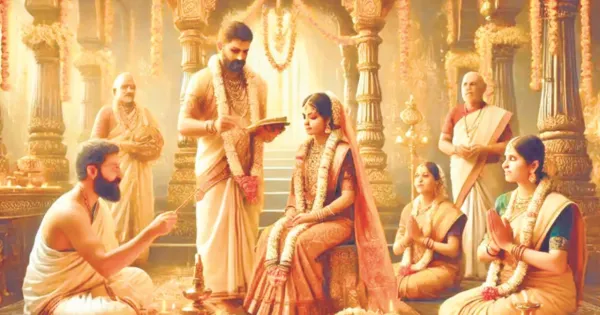
In the general sense, culture means to improve, the process by which defects, filth and impurities are removed and qualities are infused into it, is called culture. Just as a goldsmith makes Kundan by heating and purifying gold, similarly rituals have been arranged to make human life better. There is mention of 16 and 48 sanskars in our scriptures. Sanskar is a continuous process, through which man develops purity, virtue and divinity in his life. Just as colors are added to a beautiful picture to give it completeness, similarly values are necessary for the overall development of personality and character.
Through the sacraments, the inner refinement of man takes place and his spiritual upliftment is considered like rebirth. Our sages have arranged various rituals to mark each important stage of life from conception to death. Today modern science has also started accepting many aspects of Indian cultural tradition. Medical methods like acupressure and acupuncture developed on the basis of Karnavedha ritual are examples of this. In ancient times, the tradition of keeping Shikha under the Chudakaran Sanskar was also considered to be related to the safety and health of the body. But due to western influence, society’s faith in values has weakened and many values have become endangered.
The conception ceremony has special importance among the sixteen rituals. Unfortunately today it is almost forgotten. In Indian culture, procreation is not just a matter of enjoyment but is considered a sacred sacrifice. The purpose of conception is not just to have a child, but to create an excellent, quality and cultured child. That is why special rules, restraint and spiritual preparation for conception have been prescribed in the scriptures. According to ancient tradition, husband and wife used to prepare themselves mentally and spiritually by worshiping gods, chanting, penance, restraint and prayer, considering the nature and qualities of their child. They developed vigor, brightness and purity within themselves and conceived at auspicious times. This is called spiritual healing ritual. Its objective was to create superior offspring not only physically but also at the mental and spiritual level.
Here marriage is also considered a sacrament. This is not only the beginning of married life, but also the gateway to restraint, responsibility and religious life. The purpose of marriage is also considered to be the creation of ideal children for the family and society. For this reason, importance has been given to time, circumstances and mental state in both marriage and conception.
It is clearly said in the scriptures that the best children are born only if the body and mind of man and woman are healthy, pure and happy. The mental state of the parents at the time of conception affects the fetus. Maharishi Charak has also mentioned that the feelings that the parents have at the time of conception help in building the personality of the child. Therefore, at that time, inspiration has been given to think the same while wishing for religious, learned, brave and virtuous children.
The special importance of time and period for conception has also been mentioned in the scriptures. There is a method for conceiving by considering the season, constellation, date and other astrological circumstances. The purpose behind this was that the couple should live a balanced life and remain in a balanced state of mind. The scriptures consider conception during day time as inappropriate and the appropriate time at night is considered the best. The mother’s diet, thoughts and behavior are considered extremely important during pregnancy. It has been believed that the mother’s environment and thoughts have a deep impact on the fetus.
In Indian tradition, examples are given of Prahlad and Abhimanyu, who attained the best values and knowledge during pregnancy itself. Therefore, pregnant women have been advised to attend satsang, study good scriptures, have good thoughts and live in a positive environment. The basic purpose of values is to make man restrained, virtuous and spiritual. Today, due to indulgent lifestyle and incontinence, many traditional rituals have been neglected. As a result, there is a decline in morality, discipline and family values in life. What is needed is to understand the real purpose of the rituals and see them not as superstition but as a process of refinement of life.
Our scriptures also tell that the superiority of a child is not in numbers but in qualities. There have been many great personalities in history who single-handedly gave a new direction to the society and nation. The importance of great men like Lord Shri Ram, Bhishma, Adi Shankaracharya and Prahlad is not because of their numbers, but because of their qualities, character and ideals. The purpose of rituals is not just religious rituals, but to make human life better. Especially the essence of the conception ceremony is that the future generation should become superior physically, mentally, morally and spiritually.
Acharya Pradeep Dwivedi Spiritual Writer