
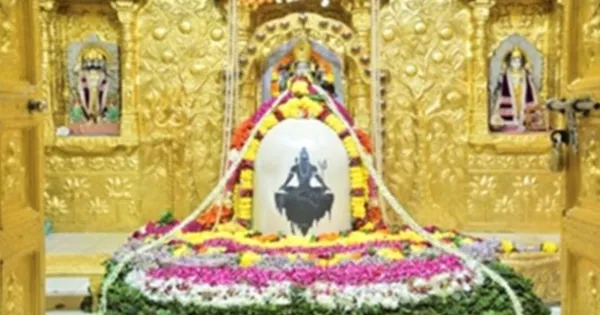
Hanyate Hanyamane Shariray i.e. even if the body is destroyed, the soul is not destroyed. The spirit contained in this verse of Srimad Bhagavad Gita and the most vibrant form of the eternal consciousness of Indian civilization is visible in the Somnath temple situated on the southern coast of Kathiawar region of Gujarat. Somnath, considered the first among the twelve Jyotirlingas, endured many attacks and destruction in history, but stood up again every time and the sound of its aarti, bells and reverence never stopped. – Gajendra Singh Shekhawat, Union Minister of Culture and Tourism, Government of India.
Prabhas Patan great pilgrimage site since ancient times
Somnath
Sanatan Dharma faced many challenges in thousands of years of Indian history. In times of political change, invasion and change of power, temples, monasteries and knowledge centers were damaged, their structures were altered and the systems that protected them were also affected. Despite this, the Indian spiritual tradition not only survived but also reinvented itself with time. Its greatest strength was that despite institutional damage and political instability, its spirit never died.
Temples in ancient and medieval India were not only places of worship, but also centers of economic, cultural and social life. Due to their deep connection with the monarchy, they became the first targets in times of war and conflict. The attack on Somnath by Mahmud Ghaznavi is one of the most talked about events in history. In Persian texts it was presented as a victory, while in Indian tradition it was remembered as a tale of suffering, struggle and reconstruction, but the historical truth is that Somnath never disappeared from reverence. Many kings including the Chalukya rulers rebuilt it and it continued to be a center of faith. Many such incidents are seen in other parts of India also.
The history of Somnath is not just the story of an invasion. Prabhas Patan has been a great pilgrimage site since ancient times. It was known by names such as Prabhasa-pattana, Shiva-pattana and Prabhaasa-tirtha in various texts and traditions. There is a confluence of three holy rivers here and this is considered to be the place where the last rites of Lord Krishna took place after his death. Nearby are Vairagya Kshetra and Gopi Pond, from where Gopi sandalwood is obtained. The journey to this entire region is considered extremely sacred in the Indian pilgrimage tradition. This region is also mentioned in many historical records and archaeological reports based on the ancient heritage of Kathiawar and Gujarat.
Center of Shaiva and Vaishnava traditions
Somnath is also a symbol of India’s inclusive cultural tradition. It is the center of a wonderful confluence of Shaiva and Vaishnava traditions and reminds us that Indian culture has always been pluralistic and inclusive. The modern chapter of Somnath’s renaissance in independent India began on 12 November 1947, Diwali, when the country’s first Deputy Prime Minister and Home Minister, Sardar Vallabhbhai Patel, visited the holy site. Amidst the pain of partition, Sardar Patel resolved to rebuild the Somnath temple. This was not just a decision to rebuild a temple, but a historic attempt to revive national consciousness. After this, work started towards developing Somnath as a cultural and intellectual centre. The consecration, which took place in the morning on 11 May 1951 in the presence of the first President of India, Dr. Rajendra Prasad, gave new strength to the cultural memory and self-confidence of the entire nation.
Effort to connect modern society with cultural roots
Today, when India is moving towards ‘India @ 2047’, these civilizational values associated with Somnath become even more relevant. In this era of technological change and global uncertainties, India sends a message to the world that development does not mean abandoning compassion and power does not mean abandoning restraint. Somnath teaches us that true leadership is not built on mere ability, but on memory, wisdom and commitment to human values. With this in mind, “Somnath Swabhiman Parv 2026-27” has been envisioned. This year-long national event is dedicated to the spiritual power, cultural continuity and civilizational consciousness of Somnath Jyotirlinga. The way Somnath was re-established with the collective resolve of the society, even after facing destruction several times for centuries, is a living example of India’s cultural self-power and national self-respect.
Two important historical milestones were commemorated through this festival, which started between 8 to 11 January 2026. One thousand years since the first recorded attack on Somnath in 1026 and 75 years since the re-inauguration of the rebuilt temple in 1951 after independence. The objective of this event is to establish Somnath as a symbol of national unity, cultural consciousness and collective memory. Yatras, cultural events, dialogues, educational programs and coordinated activities will be organized at various Jyotirlingas, States, Union Territories, Districts and Shivalayas across the country till the major national event to be held on 11 May 2026. Under the leadership of Prime Minister Narendra Modi, who is also the Chairman of the Shri Somnath Trust, Somnath has witnessed a new renaissance. Administrative reforms, infrastructure development, heritage conservation and cultural initiatives have further strengthened Somnath as a vibrant spiritual centre. Through environmental balance and women-empowerment based service initiatives it is shown how Indian civilizational values can move forward with modern responsibilities and inclusivity. Somnath Swabhiman festival is an effort to connect the modern society with its cultural roots. This reminds us that Somnath is not just a temple. Its real strength lies in the values, traditions and responsibilities that have been passed on from generation to generation. That is why today Somnath is not just a renovated temple, but a living pilgrimage. Somnath gives an important message for India moving forward in the twenty-first century – any civilization remains strong when it remains connected to its roots, keeps adapting with the times and takes everyone along. May this legacy of Somnath continue to inspire us – to build purposefully, to behave balanced and to move forward while being conscious of our identity.