
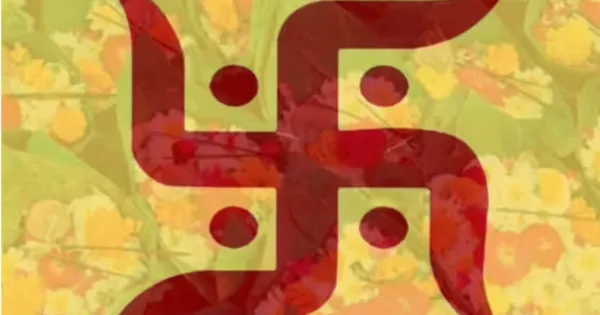
Symbols have great importance in Indian culture. These symbols contain many secrets within themselves, but only those who deeply know and understand these symbols of culture can know their secrets. For the rest of the people, symbols are just symbols. ‘Swastika’ is also an important symbol in Indian culture. It is considered a symbol of the Sun. However, Swastika has countless dimensions in Indian culture and it has been expressed in different ways. The general meaning of Swastika is one who gives blessings, does auspicious or virtuous work. This is expressed in the form of establishment of auspicious or auspicious works and virtuous deeds. -Pt. Manoj Kumar Dwivedi Astrologer, Kanpur
Swastika symbol ‘Om’
The meaning of Swastika is such an existence which is full of good feelings, beneficial and auspicious, where there is not even a trace of fear of inauspiciousness, inauspiciousness or evil. Swastika means such a being, where only the feeling of welfare and auspiciousness is inherent, where good feelings for others are inherent. Therefore Swastika is depicted as the power and symbol of welfare. The statue of Lord Ganesha, the remover of obstacles, also has an association with the Swastika symbol. The trunk, hands, legs, head etc. parts of Lord Ganesha are painted in such a way that they appear as the four arms of the Swastika. ‘Om’ is also considered the symbol of Swastika. ‘Om’ is the origin of creation, power, strength and life are embedded in it. This letter has the highest recognition in the names of God. Therefore, Swastika is a symbol which is supreme and also auspicious and auspicious.
Important Swastika for invocation
Swastika has been described as auspicious and beneficial in the scriptures. In ancient times, we had a tradition of writing invocation before doing any good work. It was not possible for everyone to write this invocation, but everyone knew the importance of this invocation and also wanted to take advantage of it. Therefore, the sages conceived the Swastika symbol, so that everyone’s work can be accomplished auspiciously. In religious and auspicious functions, carving Swastika with rice etc. on the altar is considered auspicious.
increases positive energy
Swastika destroys negative energy wherever it is made. It has the amazing ability to attract the flow of positive energy in the universe towards itself. Taking this as the basis, Swastika is made from different objects, which have different meanings. For example, Swastika made from vermilion or Ashtagandha is considered auspicious and satvik. Wherever Swastika is, it destroys negative energy and increases positive energy. In this way, Swastika is a great and auspicious symbol, which is always beneficial.
Evidence in many cultures of the world since ancient times
The Swastika is also considered an ancient universal symbol. Evidence of this has been found in many cultures of the world for thousands of years. In Indian culture, Swastika is considered a symbol of good luck and auspiciousness in Hinduism, Buddhism and Jainism. In Hinduism it is a symbol of Surya, Lord Vishnu, ‘Om’ and the universe. In Buddhism it represents the footprint of Buddha and in Jainism it represents one of the 24 Tirthankaras. Evidence of this is found before the Indus Valley Civilization in the Indian subcontinent. The Swastika symbol has been found in seals dating back to 3,000 BC. Thus the Swastika is a universal symbol, used for auspiciousness and well-being in various cultures, while in India it has special spiritual significance.