
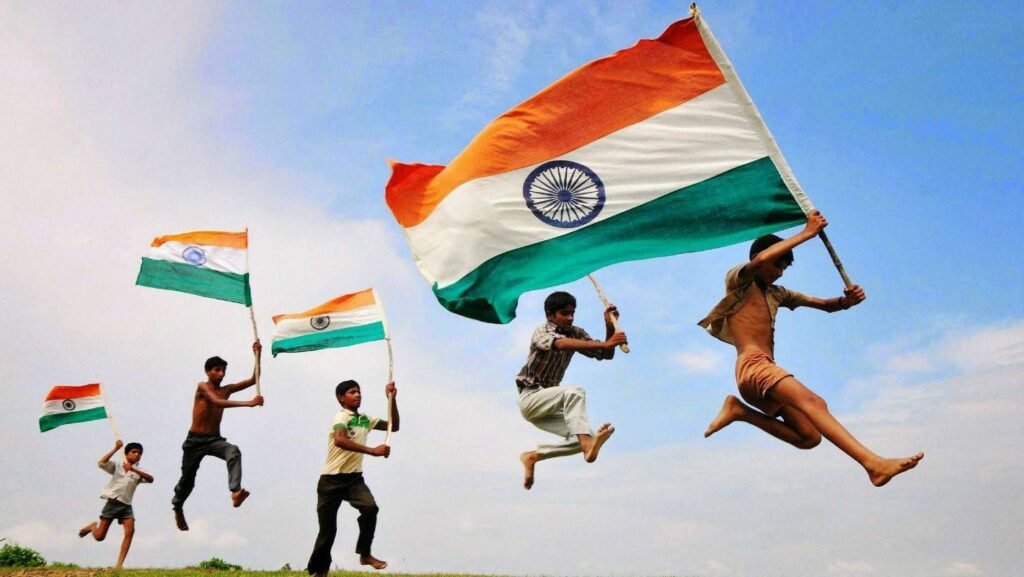
15 August 1947 was written in golden letters in the history of our country. The value of freedom was understood by the people of that time who were subjugated. The country which was called the ‘golden bird’ became a cage of pricking bars for them. The movement to gain independence, which started in 1857, ended on 15 August 1947 and our country became independent. India got independence after two hundred years of slavery and hundred years of struggle. Here are some interesting facts related to this Independence Day about which very few people are aware.
Why was independence declared at 12 midnight on 15 August 1947?
According to astrologers, the dates that were declared for India getting independence (between 3 June and 15 August 1947) were inauspicious and unholy. But Lord Mountbatten was adamant on 15 August. Astrologers came up with the solution that India’s independence should be announced at 12 o’clock in the night because according to English time the new day starts at 12 o’clock in the night whereas according to Indian time the new day starts at sunrise.
Our national flag-
Every independent country has its own national flag. There was no official flag of our country. In 1906, an unofficial flag consisting of horizontal stripes of red, yellow and green was hoisted in Parsi Bagan Chowk (Green Park), Calcutta. The flag hoisted by Bhikaji Cama in 1907 was also similar to this flag but it had a lotus flower on its upper strip. The third flag arrived in 1917. In 1921, at the All India Congress Committee meeting, a young man from Vijayawada gave a flag to Gandhiji, which had red (saffron) and green colors, which were symbols of Hindu and Muslim religions. Later, as a symbol of other religions, Gandhiji added a white stripe and a moving charkha to it. On July 22, 1947, the Constituent Assembly replaced this flag as the national flag and replaced the charkha with the Dharma Chakra of Emperor Ashoka. Thus the tricolor of the Congress Party became the national flag of independent India.
Our national anthem-
At the time of independence, India had no national anthem of its own. Jana-Gana-Mana, written by Guru Rabindranath Tagore, was given the place of national anthem on 24 January 1950. It is said that in 1911, when Delhi was made the capital of India in place of Calcutta, Guru Rabindranath Tagore was asked to write a song to welcome George V. He wrote the poem ‘Jana-Gana-Mana’ in Bengali language which had five verses. But only its first verse was accepted as the national anthem.
Absence of Mahatma Gandhi in the celebrations of 15 August 1947-
When independence was being celebrated in the Red Fort, Delhi, Gandhiji was sitting on a fast in Bengal, thousands of miles away from there. He was fasting there to stop Hindu-Muslim riots.
Merger of Goa-
At the time of independence, Goa was separated from India and made a Portuguese state. On 19 December 1961, the Indian Army conquered Goa and made it a part of India again.
Letter of Nehru and Sardar Vallabh-
When the documents of getting independence were ready on 15th August, Nehruji and Sardar Vallabhbhai Patel wrote a letter to Mahatma Gandhi saying that this celebration is the celebration of Independence Day and being the Father of the Nation, he should join the celebration and bless him. Mahatma Gandhi replied that when Hindus and Muslims were killing each other in Calcutta, how could he celebrate instead of stopping the riots.
Nehru’s historical speech-
At midnight on 14 August 1947, Pt. Jawahar Lal Nehru gave his historic speech ‘Tryst with Destiny’. He gave this speech from the Viceroy’s Lodge which is today known as Rashtrapati Bhavan.
Determining the border line of India-Pakistan-
Although Pakistan was divided on 14 August 1947 and India became officially independent on 15 August 1947, still the border line between these two was not formed. The Radcliffe Line announced their boundary lines on 17 August.
Newspaper headlines on 15 August 1947-
The morning of 15 August 1947 brought a new dawn for every Indian. The morning starts with the newspaper. This morning’s newspapers were also filled with stories of freedom. The headline of Hindustan was ‘Good morning of freedom in India after centuries of slavery’. Hindustan Times was also not far behind, its first news was ‘India Independent: British Rules End.’ India was also in the headlines of world’s famous newspapers.
Lack of promotion of independence-
Due to lack of communication media on 15 August 1947, this news could not be received by the entire countrymen. At that time, news was published only in newspapers and at some places was broadcast on radio. Due to their scarcity in remote areas, this news reached here late.