
China has converted its old J-6 fighter aircraft (Chinese version of Soviet MiG-19) into supersonic drones. This drone will be used for saturation strikes (large attacks). It was first displayed before Changchun Air Show on 16 September. Can India also turn its old MiG-21 aircraft into drones similarly?
China plan to convert the G-6 into drone: What is it?
The J-6 aircraft of the 1950s and 60s were once the main strength of the Chinese Air Force. Like the MiG-21, it is also a strength of the Indian Air Force. It is also going to retire. J-6 is now retired, but China has converted it into unmanned aircraft.
The Indian Army launched its first overhul VT-72B ARV.
According to a report by @Rupprechtdeino account, cannon, ejection seat and fuel tanks have been removed. Instead, it has an autopylot, automatic flight control, payload pylon and a terrain-fioling navigation system.
It first flew in 1995, but will now be used for war. By 2022, over 600 J-6 aircraft have been converted, and are in over 1,000 stocks. Its firepower is 350 miles (about 560 km), supersonic motion (faster than sound) and a payload of 1,000 pounds (450 kg).
Use
Training targets: providing a real goal to pilots and air defense teams.
Trick: To attract enemy’s shelling.
Strike platform: attacking with light weapons.
Region: risky reconnaissance.
China’s advantage: cheaper (10 times lower than new drones) and comprehensive use. Stored in strong shelters near Taiwan. It is a part of saturation attack (weakening the enemy’s protection from a large number of drones). The US used the QF-4/QF-16 in this way. Azerbaijan used AN-2 in the Nagorno-Karabakh war.
India’s MiG-21: What is the situation?
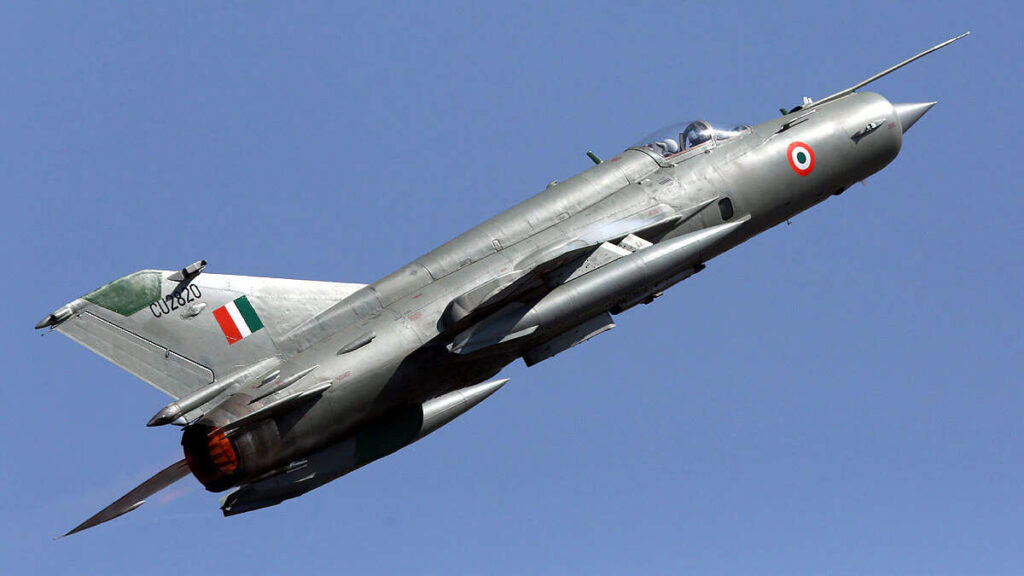
India has MiG-21 ‘Bison’ jet, which belong to the 1960s. They are known as “flying coffins” due to the large number of accidents. The last squadron will retire on 26 September 2025. Currently, there are only 40–50 MiG-21 left, which will be retired by 2027. The squadron number of the Indian Air Force will decrease to 29 compared to 42.
India should plan to convert MiG-21 into drone. Either as a strike drone or as a target drone like China. For testing of DRDO SAM missiles (Akash-NG, QRSAM, XRSAM). Mig-21 speed (Mac 2), height (17 km), and dynamics will imitate enemy aircraft.
Cost: Conversion ₹ 5-10 Crore per unit (₹ 50-100 crore cheaper than UCAV).
Uses: Air Defense Test, Stealth and Self Drone Simulation. Operation proved useful against the Pakistani drone in Sindoor.
Project Kusha: MiG-21 will be a target of long distance SAM.
The HAL had proposed to convert MiG-21 into a fighter drone at the CATS program, but the Indian Air Force refused. There were expensive maintenance and security risk causes behind this. Most of the MiG-21 will be either stored or scraped.
What can India do … Is it possible to do like China or not?
Yes, India can turn MiG-21 into drones like J-6 in China, but current plans are limited to targeted drones. Research is underway to convert MiG-21 into an unmanned version. Vietnam is also planning to do so. It is cheap. Old stock of over 1,000 MiG-21 can be used. But challenges …
Old Avionics: Lack of fly-by-wire.
Security: Accidents due to communication failures.
Budget: UCAV conversion is expensive.
For saturation attacks like China, India should focus on CATS (indigenous UCAV) and Alfa-S self -ram drones. It is possible to convert MiG-21 into a targeted drone, which will increase the sam capabilities of DRDO. In the future, Tejas will replace MK2 and deadly UCAV, MiG.