
: Sunday, July 12, 2026 6:23 PM
New Delhi. Imagine the scene! January 2008, Perth. India’s special envoy reached out to the country, which has one of the world’s largest uranium reserves, seeking uranium for the energy-starved country with a population of over a billion. But the answer he got was ‘No.’ India was told, ‘First sign the Nuclear Non-Proliferation Treaty (NPT), otherwise go back.’ Returned back to India. Now the situation has changed. Year 2026, month July and place Melbourne, Australia. The Prime Minister of Australia stands with the Prime Minister of India Narendra Modi and announces that Australia will provide uranium to Indian nuclear reactors. This time no exhortation, no conditions, no demand to sign a treaty that India has respectfully rejected for decades. Respect given to India only as a responsible nuclear power. The door which was once closed for the ambassador of India is now open for the leader of India. Between these two scenes is the story of Prime Minister Modi’s visit to Jakarta, Melbourne and Auckland. This is not just the story of the journey, but the story of doors that remained closed to India for decades and are now opening one by one.
The fuel that was denied!
The history of Uranium must be told in full, because memory is the first to be affected due to political convenience.
In 2006, when the US was pursuing civil nuclear cooperation with India, Australia did not support it. In 2008, Australia also withdrew from its earlier agreement in principle. This situation continued throughout the UPA regime. Delhi requested, but Canberra refused. The surprising thing was that Australia refused to give uranium to democratic India and kept discussing its sale to China.
By the time the UPA government was voted out of power, there was no way for legal supply of Australian uranium to India. Within about 100 days of assuming power, Prime Minister Modi signed the long-pending civil nuclear cooperation agreement in September 2014.
The final administrative hurdle was also cleared in Melbourne this week and supplies began, a step towards India’s target of 100 gigawatt nuclear power capacity.
It is important to understand the change. The change did not come in India’s position regarding the treaty which India did not accept for the right reasons. The change came in the way the world looked at India and the way the rules were followed.
India’s new role in defense sector
If Melbourne changed what India could buy, Jakarta changed what India could now sell.
For seventy years, India’s defense story was a buyer’s story, where one had to stand in queues outside foreign capitals. This situation changed in Jakarta.
India and Indonesia signed agreements for the supply of BrahMos supersonic cruise missiles. With this, Indonesia became the third country after Philippines and Vietnam which expressed confidence in Indian defense technology. Apart from this, agreements related to ‘Astra Air-to-Air Missile System’ were also signed.
The credibility of BrahMos is linked to its actual combat experience. South-East Asia’s largest economy chose Indian defense capability in view of the changing security environment. It is not just a deal, but a sign of trust and confidence.
Turning geography into strategy
The port agreement signed in Jakarta is more important than missiles. India and Indonesia will cooperate in the development of Sabang Port located at the entrance to the Strait of Malacca. It is about 160 kilometers away from India’s upcoming Great Nicobar Transshipment Hub.
Two ports, two flags, but one sea route that affects almost one-third of the world’s trade.
Both countries are also increasing cooperation in the field of important minerals. Indonesia has about 60 percent of the world’s nickel reserves.
Indonesian President Prabowo Subianto honored Prime Minister Modi with the country’s highest civilian and military honor ‘Bintang Adipurna’.
After this, Prime Minister Modi went to Yogyakarta, where India pledged cooperation in preserving this great Hindu heritage amidst the thousand-year-old Prambanan temples.
Missiles for the present, ports for the future and temples for eternity combines three levels of diplomacy in a single journey.
trade at the speed of confidence
The same pattern is visible in the field of business also. India-Australia bilateral trade has increased by 55 percent after the 2022 trade agreement and the Prime Ministers of both the countries have directed for early completion of the Comprehensive Economic Cooperation Agreement (CECA).
Australian investment organization ‘Australian Super’ announced an investment of 500 million Australian dollars in India. Prime Minister Modi also invited Australia’s $4 trillion pension fund to invest in India’s infrastructure.
The gap of four decades ended with a jerk in one morning.
The story of New Zealand also reflects this change. For the first time in four decades, an Indian Prime Minister visited New Zealand. Trade negotiations were pending for years, but the current government swiftly completed the free trade agreement.
Amid the traditional ‘Maori Powiri’ welcome ceremony in Auckland, Prime Minister Modi announced the new strategic partnership and the 2030 Roadmap, which includes maritime security, counter-terrorism cooperation, cyber defence, a trade target of NZ$7 billion and a logistics agreement between the Indian Navy and the New Zealand Defense Force.
Now the Indian Navy ship can receive aid and supplies in Auckland. This shows that India’s maritime partnership is expanding from the Indian Ocean to the South Pacific.
One strategy opened many doors
When these achievements are seen together, a picture emerges. A country which tried to keep it away from uranium for two decades is now reaching India. The defense systems which India once imported, are now exporting them. Trade agreements that have been stuck for years are being completed rapidly. The same capitals are now paying respect to the leader of the country which was once preached on treaties.
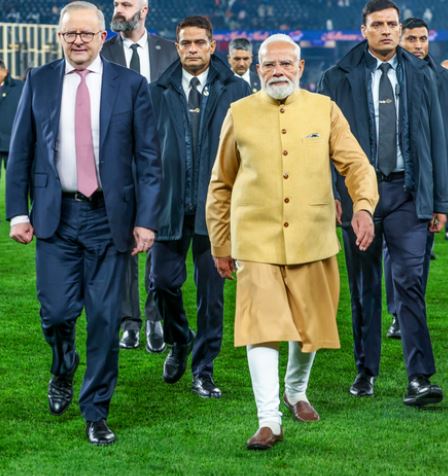
This is not a mere coincidence, but the result of credibility built over years. Countries respect people whose role and influence they value. When the Prime Minister of Australia stands with Prime Minister Modi in front of a large gathering of the Indian community at Marvel Stadium in Melbourne, it is not just a formal respect but an acknowledgment of India’s growing global importance.
finally a thought
Centuries ago, the ships of Kalinga and Chola empires went to the East through these sea routes carrying trade, culture and civilization. The stones of Prambanan still bear testimony to that history. This week the Indian Prime Minister reconnected with that ancient path! Not for conquest, but with the means of partnership, and then found every port open.
The doors do not open automatically. To open them one has to knock with one’s ability, patience and respect.
The world made India wait for decades. This wait ended under the leadership of Prime Minister Modi. India no longer just knocks on the doors of the world, but the world is opening its doors for India.
(The author is a senior advocate of the Supreme Court of India.)
—
Read this also – Click to read the news of your state/city before the newspaper.