
: Monday, 04 May 2026 10:53 PM
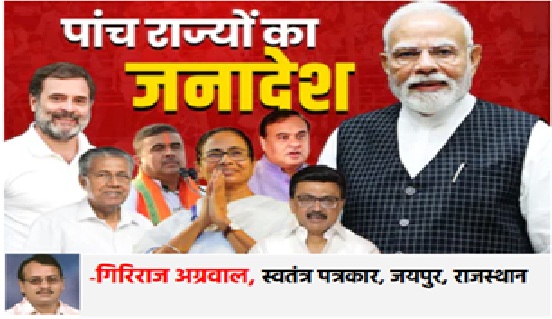
The lines drawn by these election results of May 2026 on the canvas of Indian politics will not be limited to just five states. Rather, the ‘domino effect’ of these results will also fall on states like Uttar Pradesh and Punjab in the coming times. Also, for parties like Congress and Trinamool Congress (TMC), it is time to re-evaluate survival and strategy. The West Bengal result is undoubtedly the biggest political event of 2026.
BJP’s achievement of majority in this state, which was considered an impregnable fortress of Mamata Banerjee for the last one and a half decade, is a ‘paradigm shift’. Not only ‘anti-incumbency’ but also serious allegations of corruption and dissatisfaction arising at the organizational level played a big role in the downfall of Trinamool Congress. Here, BJP successfully capitalized on the cultural narrative of ‘Sabka Saath, Sabka Vikas’ as well as ‘Sonar Bangla’, which redefined the local identity. Mamata Banerjee’s declining vote bank makes it clear that ‘identity politics’ alone is no longer enough in the state; Voters have become more aware of mainstream development and administrative transparency. In the coming year, the politics of Uttar Pradesh and Punjab will breathe in the shadow of these results. The ‘saffronisation’ of Bengal and the ‘cinematic rise’ of Tamil Nadu are writing a new and uncertain script of India’s electoral democracy, where voters no longer take any party for granted.
Tamil Nadu: New superstar of Dravidian politics
Tamil Nadu, the most important state of South India, has once again shocked the world. Ignoring the decades-long ‘bi-polar’ politics of DMK and AIADMK, actor-turned-politician Thalapathy Vijay’s party ‘Tamilaga Vetri Kazhagam’ (TVK) took a decisive lead. This victory was won by M.K. There is a confluence of a silent protest against Stalin’s administration and new hopes among the youth. The way Vijay Thalapathy advocated modern administrative reforms along with Periyarist principles influenced both urban and rural areas of Tamil Nadu. The continued weakening of the AIADMK and the BJP increasing its vote share shows that the state no longer wants to remain confined to the shell of regionalism, but is looking towards a new and energetic leadership.
Kerala and Assam: sustainability versus alternatives
The collapse of ‘Red Fort’ in Kerala is an alarm bell for leftist politics. The people of Kerala have re-embraced their traditional nature of changing power every five years and have given the Congress-led UDF a chance. The allegations of gold smuggling and financial mismanagement leveled against the Pinarayi Vijayan government have tarnished the credibility of the LDF’s ‘development model’.
On the other hand, in Assam, Himanta Biswa Sarma once again proved that he is a magician of election management. The mandate of Assam shows that the BJP’s stance on issues like security, border management and cultural preservation is resonating with the local population. The main reasons for the defeat of Congress and its allies were lack of effective leadership and disunity among the minorities.
Puducherry: victory of coalition religion
N in the Union Territory of Puducherry. Rangasamy’s efficiency and his alliance with the BJP ensured his return to power. Here voters preferred the ‘double engine’ growth mantra rather than instability. Although the opposition alliance fought on the strength of social welfare schemes, organizational strength ultimately gave the NDA the edge.
New horizon of Indian politics:
The overall analysis of these results suggests that Indian politics is now moving towards a balance of ‘charismatic personality’ and ‘grassroots actions’. These 2026 election results are not limited to just the change of state capitals; They are laying a new chessboard for the 2029 general elections. For regional parties, this is a time for introspection on their working style, while for national parties, this is an opportunity to make their acceptance more inclusive. In times to come, ‘good governance’ and ‘youth aspirations’ will be the main driving forces at the center of politics in these states.
Impact in Punjab elections:
The rise of ‘Thalapathy’ Vijay in Tamil Nadu has given a new message to Indian politics that voters are now bored with traditional parties (INC, AAP, SAD) and are looking for new, honest and charismatic faces. In Punjab, which has already been the center of change politics, the effect of this ‘Tamil Nadu model’ can be seen in 2027. Here, new regional organizations or faces will get strength to fill the void created by the weakening of Akali Dal and Congress. The voters of Punjab will learn from the results of Bengal and Kerala that ‘change’ has now become the mainstream choice over ideology.
Impact on Uttar Pradesh:
BJP’s historic victory in West Bengal will act as a ‘propeller’ for the upcoming 2027 assembly elections in Uttar Pradesh. After registering victory in a complex state like Bengal, BJP’s organizational confidence will be sky high. Its direct impact will be visible in UP, where the government led by Chief Minister Yogi Adityanath will now enter the fray with a more aggressive narrative. Bengal’s victory will give a message to the workers of UP that no ‘fortress’ is invincible. However, Congress’ victory in Kerala is a ray of hope for the opposition camps SP and BSP that if fought in a well-organized manner, the anti-incumbency wave can be converted into results.
Congress and TMC: dim and bright aspects of the future
The Bengal defeat is a matter of deep introspection for Mamata Banerjee and her nephew Abhishek Banerjee. This defeat after 15 years in power may push TMC from a ‘regional’ to a ‘provincial’ party. The national image of Mamata Banerjee, in which she was seen as the opposition prime ministerial face for 2029, is now seriously fractured. In future, TMC will have to make organizational changes like ‘surgical strike’ to save its cadre from disintegration and to get out of the image of corruption.
Congress: ‘Sanjeevani’ of Kerala and new responsibility
Kerala results are no less than a ‘life jacket’ for Congress. The comeback in Kerala has saved Rahul Gandhi’s leadership and Congress’s relevance. However, the party’s clean sweep in Bengal and Assam shows that the Congress is still weak in a direct contest with the BJP. The future of Congress will now depend on how it takes the ‘momentum’ of Kerala’s victory to UP and Punjab. The party will now have to decide whether it will remain in the role of ‘big brother’ or will be forced to follow the regional parties.
Read this also – Click to read the news of your state/city before the newspaper.
Web Title-Election Analysis: Bengal Historic Change of Power—Does It Mark the End of the Khela?