
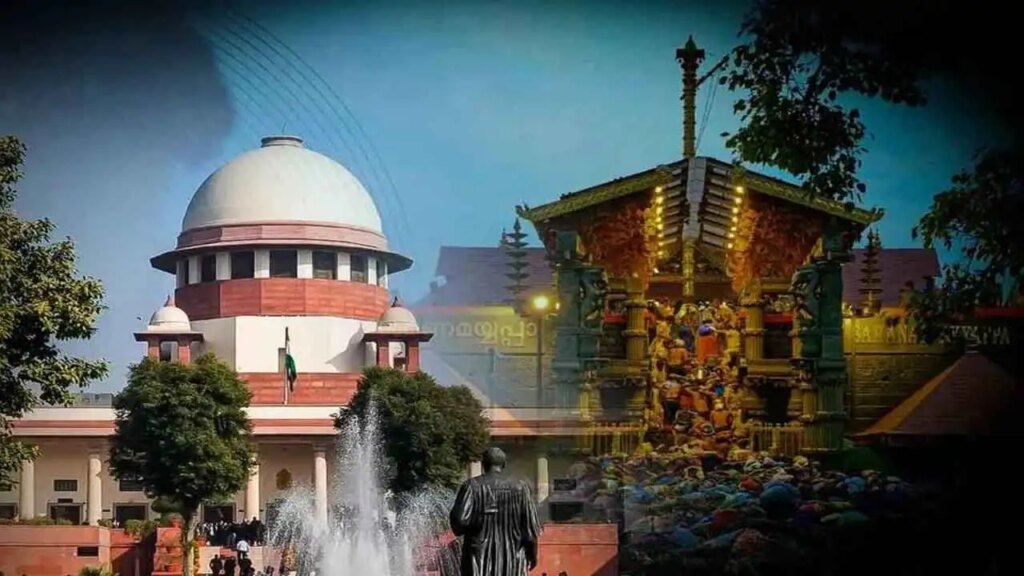
Hearing was held in the Supreme Court for the fourth consecutive day on Wednesday regarding the entry of women in Kerala’s Sabarimala temple. During this, an intense debate was witnessed between the temple management and the petitioners regarding faith, tradition and equal rights.
The Travancore Devaswom Board, which manages the temple, presented its stand in the court saying that the Sabarimala temple cannot be compared with normal public places. Senior advocate Abhishek Manu Singhvi, appearing for the board, argued that this is not a toy shop or a restaurant, but a place associated with a special religious faith, where traditions have special importance.
Singhvi told the court that Lord Ayyappa, the deity of Sabarimala temple, is considered a lifelong celibate. Based on this belief, entry of women aged between 10 to 50 years has traditionally been banned. He said that the presence of women of this age group is considered contrary to the basic religious concept of the temple and the nature of the deity.
He also argued that there are about a thousand temples of Lord Ayyappa in India, where there is no bar on the entry of women. In such a situation, if women want to have darshan, they can go to other temples. He raised the question as to why entry was being demanded only in this particular temple.
During the hearing, the Supreme Court also accepted the sensitivity of this matter. The court said that it is not easy to disprove the religious faith of crores of people and it is one of the most complex tasks for the judiciary. The court also commented that no religion or tradition can be completely weakened in the name of social reform.
However, the petitioners, on the other hand, argue that barring women from entering the temple is a violation of equality and fundamental rights. He says that the Constitution gives equal rights to all citizens, and discrimination in the name of any religious practice cannot be justified.
This matter has been a topic of discussion across the country for a long time and the challenge is to establish a balance between faith and constitutional rights. The final comments and decision of the Supreme Court can give a new direction to this debate.
Now all eyes are on what decision the court gives on this sensitive issue, which will play an important role in deciding the balance between religious traditions and social rights in the future.