
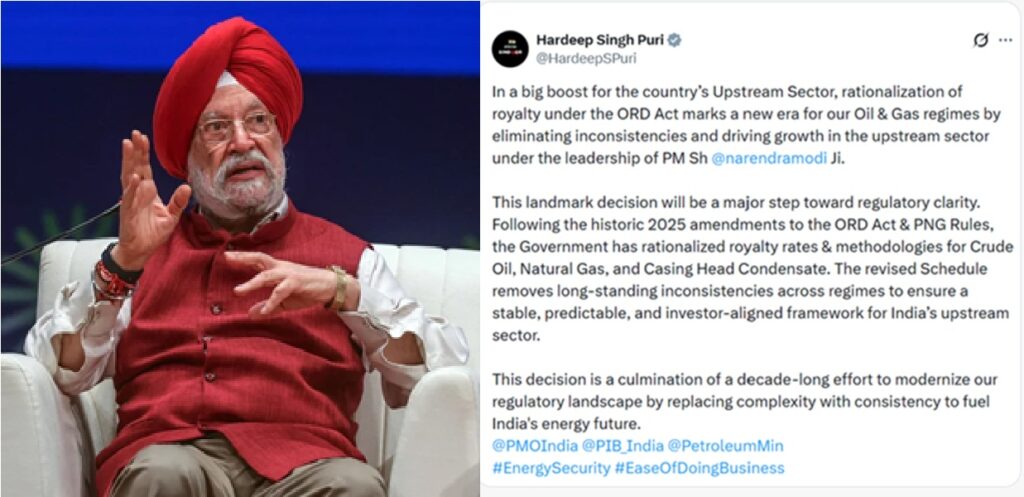
New Delhi. The Central Government has taken a major policy decision to make India self-reliant in the energy sector and to accelerate domestic oil and gas production. The Government has completely rationalized the royalty rates and their calculation procedures for Crude Oil, Natural Gas and Casing Head Condensate. This step will remove long standing discrepancies in the field of oil exploration and production. Information about this important policy reform was shared by Union Petroleum and Natural Gas Minister Hardeep Singh Puri on social media.
Regulatory clarity and investor confidence will increase
Describing this decision as historic, Union Minister Hardeep Singh Puri tweeted in his statement, “This historic decision will prove to be a huge and decisive step towards regulatory clarity in the country. After the historic amendments made in the Oilfields (Regulation and Development) Act and Petroleum and Natural Gas (PNG) Rules in the year 2025, the government has now rationalized the structure of royalty rates for crude oil, natural gas and casing head condensate.”
He further said that the Revised Schedule will completely eliminate the long standing discrepancies and disputes between different hydrocarbon regimes. Its main objective is to create a stable, predictable and global investor friendly business framework for India’s upstream sector.
Why is this policy change important?
This major reform in royalty rates is expected to have a far-reaching impact on India’s energy landscape:
Increase in domestic production: Rationalization of royalty rates will make it financially more attractive for global and domestic oil companies to explore for oil and gas in deepwater and inaccessible areas in India.
Investor-friendly environment: Foreign companies were often reluctant to invest in India’s upstream sector due to complex tax and royalty rules. The new arrangement will give them a stable and transparent policy.
Dependence on imports will reduce: India currently imports about 85 percent of its crude oil requirement from abroad. Increasing domestic production will save the country’s foreign exchange reserves and the country will become self-reliant in energy security.
Read this also – Click to read the news of your state/city before the newspaper.