
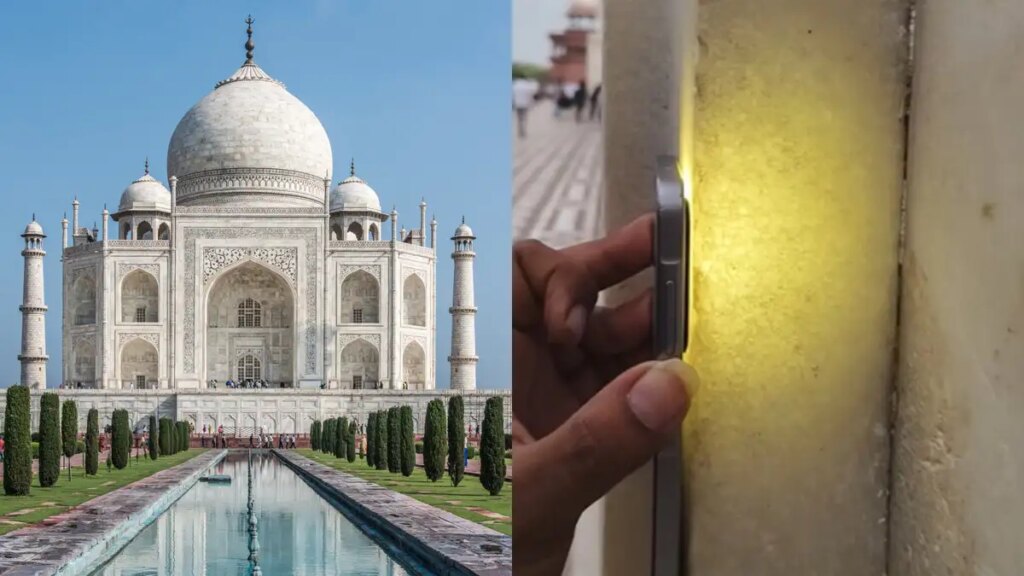
Nowadays a video is going viral on social media in which a man is shining the flashlight of his mobile phone on the white marble wall of Taj Mahal. In this video, the light is seen penetrating a few millimeters inside the wall. He then claims that this is why the Taj Mahal glows at night and was included among the seven wonders of the world. After watching the video, people’s opinion is divided; Some people consider this a unique secret of the Taj Mahal, while others say that this is a common quality of marble and there is no secret in it.
What is the truth behind this viral claim?
According to experts, the incident shown in the video is not completely wrong, but it has been exaggerated. The Taj Mahal was built from Makrana marble from Rajasthan. This marble has some transparency (semi-transparency). Because of this, light can pass through thin parts of the stone, down to a few millimeters. It is because of this quality that the Taj Mahal appears different colors at different times of the day: it can appear pale pink in the morning, bright white in the afternoon, golden in the evening and silvery blue on a moonlit night.
So, why does the Taj Mahal shine at night?
Actually, no light comes from inside the Taj Mahal. Its walls are very thick, so light cannot penetrate very deeply. Its beauty at night is due to the reflection of moonlight off the marble surface and the natural transparency of the stone. Additionally, no significant artificial lighting is cast on the Taj Mahal at night; Its brightness is the result of natural light and marble’s own properties.
Why was it included in the seven wonders?
The Taj Mahal was included in the New Seven Wonders of the World in 2007. Its fame is not because of the light penetrating through the walls, but because of its extraordinary architecture, magnificent cemetery, intricate carvings, inlay work done with precious stones, engineering prowess and the love story of Shahjahan and Mumtaz.
History of Taj Mahal
The construction of the Taj Mahal was started in 1632 by the Mughal emperor Shah Jahan in memory of his wife Mumtaz Mahal. The project took approximately 22 years to complete and more than 20,000 artisans worked on it. Today, it is included in the UNESCO World Heritage List and is one of the most famous buildings in the world. Although a viral video has shown the actual scientific properties of the Taj Mahal’s marble, it would be wrong to consider it a mystery or the main reason for its inclusion in the ‘Seven Wonders’. The real beauty of Taj Mahal lies in its design, history, workmanship and the love story related to it.