
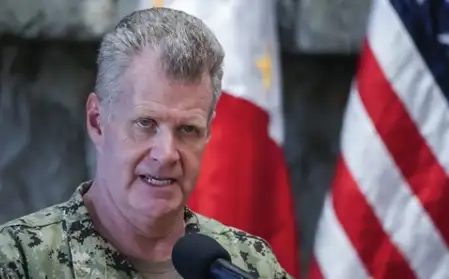
Washington, April 25 (). Admiral Samuel Paparo, head of the US Indo-Pacific Command, told lawmakers that the Indo-Pacific is “the defining strategic region of the 21st century.” With this he warned that Washington should maintain deterrence through alliances, forward military presence and technological advantage to counter the growing challenges in the region.
During a congressional hearing this week, Paparo said deterrence in the region depends on sustained operations and coordination with allies and that is our highest duty.
“We develop deterrence with dynamic combat power and conduct operations in all areas every day,” he said.
“Our allies and partners enhance our warfighting capabilities and capabilities and strengthen our deterrence capabilities,” Paparo said, citing growing cooperation in the Indo-Pacific region.
Highlighting India’s role, he said that military relations with New Delhi are continuously strengthening. It remains a priority cooperation, reflecting Washington’s broader efforts to deepen ties with key regional partners.
Paparo warned that China’s approach goes far beyond traditional military expansion. He cited strategies such as “information operations,” pressure and legal maneuvering that aim to reshape the regional order without direct conflict. “These are all contingencies that we plan for in great depth,” he said.
He also emphasized the rapid evolution of warfare and said the United States must adapt to emerging technologies and battlefield realities. “We see every day the commercialization of cheap, distributed and precise lethality,” Paparo said, citing lessons learned from ongoing conflicts.
The Admiral called for a mix of advanced and cost-effective capabilities. He said, “We need excellent equipment to destroy excellent things, while we need cheap equipment to destroy less excellent things.” He emphasized investment in unmanned systems and expandable weapons.
Senior Pentagon official John Noah echoed the administration’s stance, saying the United States wants to “deter China through force rather than through confrontation,” while also ensuring that no one power dominates the region.
“It is not intended to dominate or humiliate China. Rather, it is to protect our vital national interests in the Indo-Pacific region,” Noh said.
Paparo also expressed concern over China’s growing ties with Russia, warning that Beijing provides “90 percent of the semiconductors powering Russia’s war machine” and most of the critical industrial equipment. Described this relationship as “extremely worrying”.
In the second part of the hearing, delegates focused on broader geopolitical pressures and their impact on U.S. strategy in Asia.
Representative Adam Smith said maintaining alliances is vital to deterrence, but he warned that ongoing conflicts elsewhere are straining American resources. “The war in the Middle East is also causing huge problems in the Indo-Pacific region,” he said.
He stressed the importance of credibility with partners. “We have to let them know that we’re here for them and they can count on us,” Smith said.
Other delegates expressed concern over delays in arms supplies to Taiwan and the need to accelerate defense production. Paparo agreed to this urgency, saying supplies must be delivered “not just on time, but ahead of schedule.”
Despite concerns about misuse of resources, Paparo said the US military is prepared to deter aggression, and cited mobility, logistics and sustained presence as key elements.
—
OP/AS