
: Sunday, May 24, 2026 8:28 PM
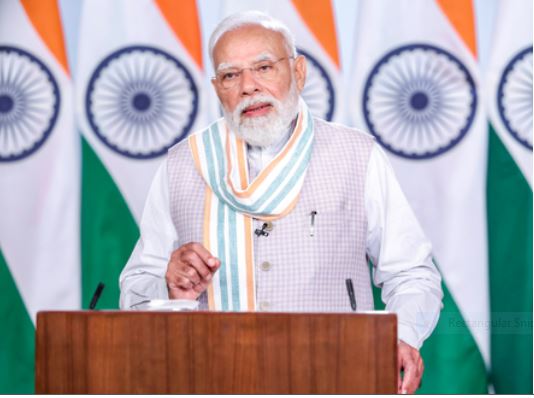
New Delhi. As Sikkim enters its 51st year as a state, Prime Minister Narendra Modi on Sunday shared an article written by Union Minister Jyotiraditya M. Scindia. The Prime Minister said that Kanchenjunga has been specially mentioned in the article and it has been described as the protector of the land, memory and consciousness of Sikkim. The Prime Minister posted on social media platform
He informed that the five gems of Kanchenjunga are continuously brightening the journey of the state, and paving the way towards ‘Develop Sikkim 2047’.”
The Union Minister wrote that Kanchenjunga, as it is called a “mountain range”, emerges in our imagination in the form of Lungta prayer flags, clouds and distant snow-capped Himalayan peaks. About a quarter of Sikkim’s land comes under the Kangchenjunga National Park. For centuries, Kangchenjunga has been enshrined in the folklore of local communities as a sacred civilizing force. The great Lama Lhatsun Chenpo poetically interprets this belief by calling the five peaks the Five Treasures of Eternal Snow, “The peak shining brightest from the rising sun is a treasure of gold, the peak in cool shade is a treasure of silver, and the other peaks are treasures of gems, grains, and sacred scriptures.”
The Union Minister said that during his recent visit to Sikkim for the 51st State Foundation Day celebrations, this saying reemerged with contemporary relevance.
Scindia said, “The first treasure is gold, and Sikkim is richer than its people. Development is sustainable only when it thrives on the trust of communities, and Sikkim offers concrete evidence of this truth in the unity and social harmony of the Lepcha, Bhutia and Nepali communities.”
He emphasized that the second treasure, silver, is reflected in the natural beauty and biodiversity of Sikkim. Teesta and Rangeet rivers are seen flowing through dense forests and clouds, while on the slopes of tea gardens, unbloomed cherry trees stand waiting for the arrival of winter.
The third are gems, and in Sikkim these gems are cultural, spiritual and civilizational. These are visible in various monasteries, in the grand Buddha Park of Ravangala, in the Bhaladhunga Skywalk overlooking the valley and in the sacred site blessed by Guru Padmasambhava himself. Sikkim preserves a sense of spirituality that seems extremely valuable and sacred in today’s turbulent world. The Minister said that this spiritual heritage now co-exists with modern aspirations.
He further said that the fourth treasure, grain, tells the story of survival. Sikkim becoming a 100 percent organic state is one of the most significant developmental achievements of contemporary India. The state’s success in organic farming, cardamom cultivation and sustainable agriculture demonstrates how mountain ecosystems can support thriving local economies.
The Minister further said that the fifth treasure, the sacred scripture, is the wisdom of Sikkim. This lies in education, where the new educational institutions and permanent campus of Sikkim State University in Namchi reflect a future that opens doors to knowledge, skills and innovation while respecting tradition. The future of a developed India will largely depend on how effectively these institutions nurture talent in the border areas of the country.
—
Read this also – Click to read the news of your state/city before the newspaper.
Web Title-Kanchenjunga, Guardian of Sikkims Land, Memory, and Consciousness: PM Modi