
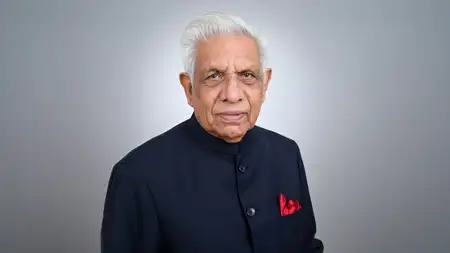
New Delhi, April 7 (). Kashmiri Lal Zakir was a litterateur who expressed the pain of Kashmir, the wounds of partition and the inequalities of the society through his pen. Poet turned writer Zakir Saheb not only included stories in his works, but also recorded the social, political and human suffering of that era which forces readers to think even today.
Kashmiri Lal Zakir was born on 7 April 1919 in Begbanian village of western Punjab, which is today in Pakistan. Zakir Saheb, who closely witnessed the horrors of partition, received his early education in Poonch and Srinagar. He later obtained BA and MA degrees from Panjab University. He dedicated his life to writing.
There was a deep consciousness of social reform in his writings. He wrote about 80 books on subjects like adult education, workers’ education, environment and population control. His major works include ‘Khajuraho Ki Ek Raat’, ‘Hatheli Par Suraj’, ‘Anguth Ka Nishan’, ‘Udas Sham Ke Aakhri Lamhein’ and ‘Zakir Ki Teen Kahaniyan’. Apart from stories and plays, he also started his career with poetry.
The violence in Kashmir after partition and the painful situation in the valley affected him deeply. He included this pain in many of his works. Stories like ‘When Kashmir was burning’, ‘Khoon Phir Khoon Hai’ and ‘Ek Ladki Bhatki Hui’ are expressions of the same pain. His writings also show deep concern on social issues like dowry system, bonded labour, women empowerment and national unity.
Zakir Saheb, who often contributed to the country through his pen, often used to say that if he had not become a writer, he would have joined the army to serve the country.
Zakir Saheb not only wrote but also worked for the society. He was the Secretary of Haryana Urdu Academy and was associated with many programs of the Government of India. He launched a campaign for adult education by adopting a slum in Chandigarh. Helped unemployed youth in career guidance and making them self-reliant. He was also the President of ‘Shramik Vidyapeeth’, from where he provided employment related assistance to the youth.
He received many honors for literary and social services. He was awarded the Ghalib Award in 1986, the National Nehru Education Award in 1991 and the Padma Shri in 2006 by the Government of India. Haryana government also honored him. Apart from Hindi, Urdu and English, many of his books were also translated into foreign languages.
Zakir Saheb died on 31 August 2016 at the age of 97. Even today his works connect readers with the truth of Kashmir, the pain of partition and human sensibilities.
—
MT/ABM