
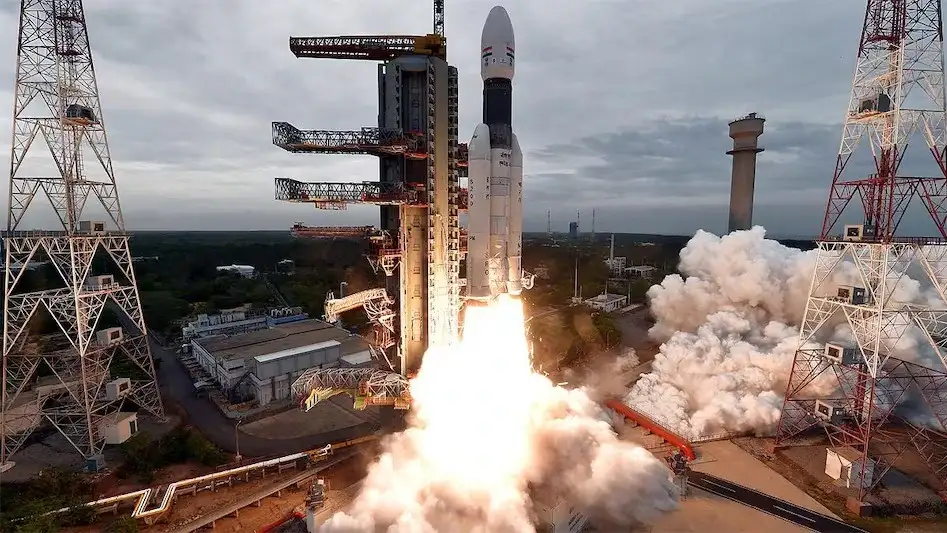
Tomorrow, on November 2, 2025, India’s famous launch vehicle, the LVM3 rocket will make its fifth flight. This flight will be known as LVM3-M5. This flight will launch India’s heaviest communications satellite, CMS-03, into space. This satellite is very important for the Indian Navy. This will not only strengthen communications in maritime areas, but will also reinforce the lessons learned from important operations like Operation Sindoor.
LVM3: India’s trusted rocket
LVM3 is the most powerful launch vehicle of the Indian Space Research Organization (ISRO). Its full name is Launch Vehicle Mark-3. This rocket is designed to carry heavy cargo into space. It has performed exceptionally well in its four flights so far. The most recent flight was Chandrayaan-3, in which India became the first country to successfully land near the Moon’s south pole. Now it’s the turn of LVM3-M5. This rocket is completely ready. On October 26, 2025, it was attached to the satellite and taken to the launch pad. Final investigation is still underway. The launch will take place at 5:26 pm from the Satish Dhawan Space Center in Sriharikota. You can watch it live on ISRO’s YouTube channel.
CMS-03: India’s heaviest communication satellite
CMS-03 stands for Communications Satellite Mission-03. It is a multi-band communications satellite, meaning it will operate on multiple radio waves. Weighing approximately 4,400 kg, it will be the heaviest communications satellite ever launched from India into Geosynchronous Transfer Orbit (GTO). GTO is the orbit from which a satellite can easily reach geostationary orbit, where it orbits above the Earth and maintains continuous communications. This satellite will operate for seven years. It will cover the Indian mainland and large maritime areas. It will have the facility of internet connectivity, video conferencing and secure data transmission. Crucially, it will provide stronger connections to remote areas, ships and aircraft. Its capacity is greater than previous communications satellites, meaning it can transmit data more quickly.
Why is CMS-03 special for the Indian Navy?
CMS-03 is primarily designed for the Indian Navy. It is also known as GSAT-7R. Naval ships, submarines and aircraft travel far out in the ocean, where signals become weak. This satellite will provide secure and fast communication to the Navy.
For example…
Enhanced Security: Naval officers will be able to keep a real-time monitor on enemy activities.
Easier coordination: Communication between different ships will be faster, allowing successful operations.
Maritime security: Surveillance will be strengthened in areas like the Indian Ocean, Arabian Sea and Bay of Bengal.
This satellite will provide the Navy with a “sea eye”. That is, every activity in the sea can be monitored. This will further strengthen the security of India’s maritime borders.
How is this satellite connected to Operation Sindoor?
Now let’s talk about Operation Sindoor. This was an important Indian military operation that took place in May 2025. The campaign lasted only four days, but it demonstrated India’s military might. However, this campaign taught a big lesson: ensuring communication and monitoring. During the campaign, the Air Force, Army and Navy needed immediate communication with each other. The ships in maritime areas had to coordinate with the air force. However, there were some delays due to older satellites.
After Operation Sindoor, the Government of India decided to strengthen military communications. Work is going on at a rapid pace on a spy satellite project worth $3 billion. CMS-03 is a part of this initiative. This will provide the Navy with communications that cannot be intercepted by the enemy. If something like ‘Operation Sindoor 2.0’ happens in future, the Navy will be able to establish better coordination with the Air Force and Army by using this satellite. Operation Vermillion demonstrated the importance of sea communications. CMS-03 will remove this weakness. This will provide a digital security shield to the Navy, which will be the key to victory in the war.
Pre-launch preparations: Everything is on schedule
Integration of the rocket and satellite was completed on 20 October. It was landed at the launch site on 26 October. Weather checks, refueling and final testing are now underway. ISRO scientists are working day and night. If all goes well, India’s new glory will shine in space tomorrow.