
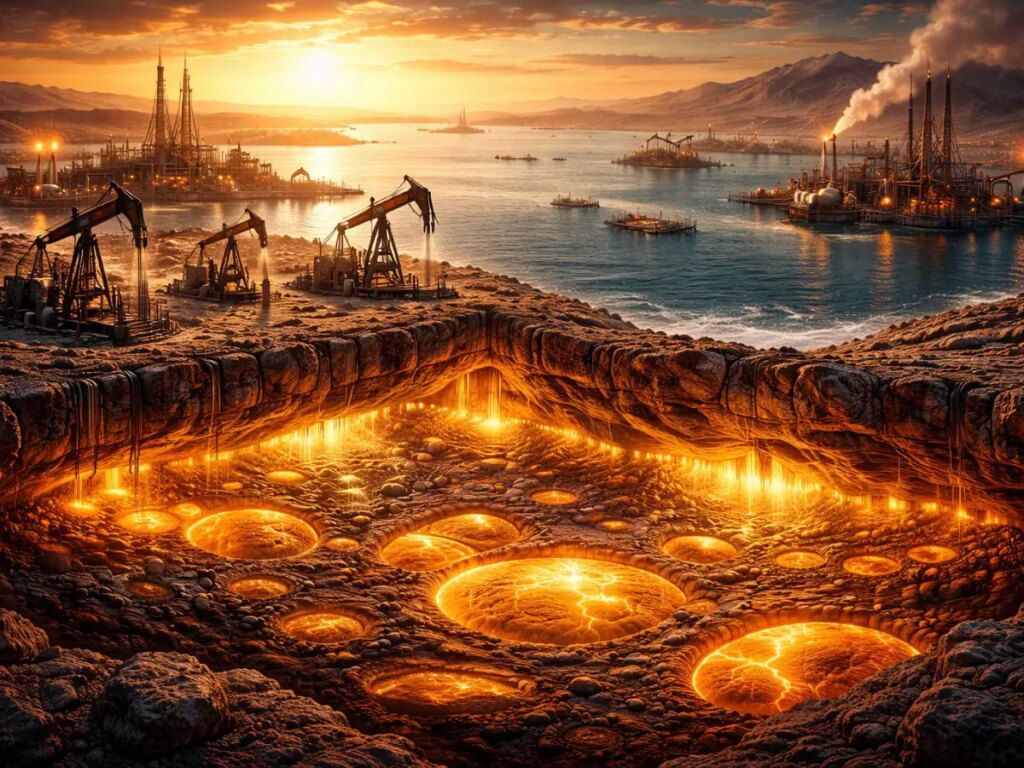
Beneath the scorching heat of the desert, rivers of oil flow, making the Persian Gulf the richest region in the world. After all, what exactly is the reason that the world’s finest and most abundant crude oil is found in this particular region? This is no mere coincidence, but a natural wonder—the result of geological upheavals that have been occurring deep beneath the Earth’s surface for millions of years. The amount of oil extracted from wells here is many times that found in countries like Russia—a fact that has made the region a global energy hub.
Collision of plates for millions of years
The oil reserves of the Persian Gulf are the result of a massive collision between two giant tectonic plates. For about 30 million years, there has been a collision between the Arabian Plate—which is moving from the southeast—and the Eurasian Plate, which is pushing in from the northeast. This constant pressure caused the solid rocks beneath the surface to bend and twist, creating dome-like geological structures. These domes acted as a natural lid—or “trap”—where oil and gas, rather than seeping out, were safely trapped and stored in one place.
Zagros Mountains and Deep Oil Basin
The uplift of the Zagros mountain range created a deep and vast basin just below the Persian Gulf. Over time, this basin filled with layers of sediments and rocks. As these layers became thicker, heat and pressure increased at greater depth. It is this combination of high pressure and temperature that begins the process of converting the organic matter trapped inside the rocks into crude oil and natural gas. This geological process eventually created an inexhaustible reservoir of hydrocarbons beneath the Gulf.
biological wonder of marine life
The most important element for oil formation is organic matter, and the Persian Gulf has been teeming with marine microorganisms since ancient times. These creatures are buried inside the limestone and sedimentary rocks of this region. According to scientists, if a rock contains only 2 percent organic matter, it has the potential to produce oil. However, in the rocks of the Persian Gulf, this organic content ranges from 1 percent to 13 percent—an extraordinary figure. This abundance is the main reason why ‘rivers’ of oil flow in this region.
Huge reserves and extraordinary wells
According to a BBC report and geological experts, there are more than 30 huge oil fields in the Persian Gulf region, each of which holds more than five billion barrels of oil. Interestingly, in terms of production, oil wells here are two to five times more efficient than wells in countries like Russia. The porosity of the rocks in this area is so extraordinary that oil comes out easily, which reduces production costs and maximizes profits.
A great ‘trap’ for hydrocarbons
Petroleum geologist Scott L. Montgomery explains that the region’s geological rock formations are among the most efficient in the world when it comes to hydrocarbon formation. The folded rock formations of this area effectively prevent oil from escaping. Since oil is formed from marine microorganisms, it moves upward through pores in the rocks; However, the “ceiling rocks”—or impermeable layers—above it trap it there. It is precisely because of this natural trapping process that a vast ocean of “black gold” has accumulated in this area.