: Friday, March 27, 2026 1:14 PM
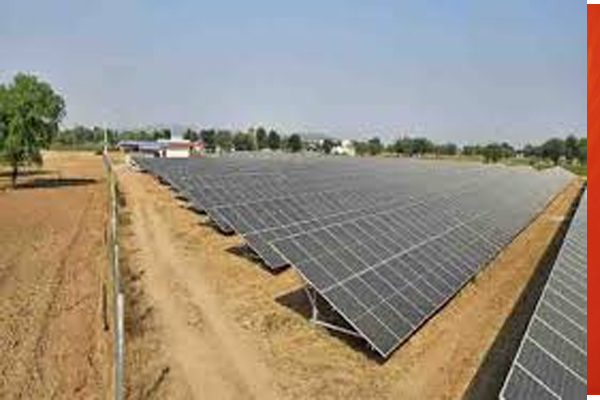
Jaipur,. Grid connected decentralized solar power plants being installed under Prime Minister Narendra Modi’s important initiative PM-Kusum Yojana have brought a new revolution in the energy sector of the state. Farmers’ dream of day irrigation is coming true with the electricity generated from these plants. Villages and houses are becoming illuminated. At the same time, with the beginning of the new era of entrepreneurship in the rural economy, the food giver has become the energy giver and the giver of fortune. This has reduced the dependence on electricity generated from coal and increased the use of cheap and pollution-free solar energy in agriculture.
So far, 1617 solar power plants of 3585 MW have been installed in Kusum Component-A and Component-C in village Dhani of Rajasthan. Out of these, 1525 plants of 3462 MW have been established in a short period of last two years and three months. These figures are enough to show the success of the widespread public participation and encouragement being given to this scheme by the state government under the leadership of Chief Minister Shri Bhajanlal Sharma.
Rajasthan first in Kusum Component-A
496 plants of 686 MW have been installed in Kusum Component-A. In this, Rajasthan ranks first in the country. Whereas in Component-C, 1121 plants of 2899 MW have been installed. Rajasthan ranks second in this. For the best achievement in feeder level solarization under the scheme, Union Power Minister Shri Manohar Lal had honored Rajasthan Discoms with the Gold Award in the annual function of All India Discoms Association held in Delhi in the month of January this year.
Farmers are getting electricity during day time
Chief Minister Bhajanlal Sharma has pledged to provide electricity during the day for irrigation to the farmers of the state by the year 2027. This scheme is playing an important role in realizing this resolution. With the electricity produced from these plants, more than 2 lakh 29 thousand farmers in the state are getting electricity for farming during the day.
Establishment of plants is gaining continuous momentum
In recent times, the pace of establishment of safflower plants in the state has increased further. On an average, three to four new plants are being set up every day in Jaipur, Jodhpur and Ajmer Vidyut Vitran Nigam area. Due to which an average of 10 MW capacity is being added to the grid every day. This year, 286 MW capacity plants have been connected to the grid in the month of January and 295 MW capacity in the month of February.
In Component-A, maximum 86 plants have been established in Bikaner district alone. After this, 34 solar power plants have been installed in Jodhpur and 32 solar plants in Jhunjhunu Circle. Whereas in Component-C, 24,561 solar pumps in Phalodi, 22,469 in Jodhpur and 22003 in Bikaner have been energized.
To make this scheme successful at the grassroots level, all three electricity distribution corporations of the state are continuously making important contributions. Speedy disposal of processes related to issuing letter of award, setting up solar plant and making power purchase agreement is ensured. As per the provisions contained in the SOP, the technical processes related to meter testing, laying of transmission lines and transformers are being completed on time.
Under the scheme, within a radius of 5 kilometers from a 33 KV grid sub-station, farmers, farmer groups, cooperative societies and solar energy producers can set up a solar plant of maximum 5 MW capacity on their own or by taking land on lease. Solar power producers are providing the electricity produced from their plants to the distribution corporations at a fixed rate through purchase contracts. In the month of February this year, 4001.29 lakh units of solar energy produced from safflower plants became available to the distribution corporations. Since the generated electricity is used at the same sub-station, the power companies do not need to develop a separate distribution or transmission system. Due to this, distribution losses are also minimized, the benefit of which is given to the distribution corporations.
More than a thousand new solar entrepreneurs have joined energy production through the solar power plants being installed under the Kusum scheme. They have got an additional source of income. This has improved their economic standard of living. Utilization of barren land has been ensured and the contribution of universally available solar energy has increased in the energy security of the country.
12 solar power plants of 23.60 MW capacity installed on Ram Navami
PM-Kusum Yojana has given new energy to the farmers of Rajasthan for empowerment and self-reliance. Under this scheme, a total of 12 solar power plants have been installed by Rajasthan Discoms on the auspicious occasion of Ram Navami, whose total capacity is 23.60 MW. 4-4 solar power plants have been established in Jaipur, Ajmer and Jodhpur. These plants are installed in Bundi, Alwar, Kotputli, Ajmer, Nagaur, Didwana, Sikar, Bikaner, Balotra and Jodhpur circles, through which solar energy is reaching the villages and hamlets of the state. By connecting 12 solar plants simultaneously to the grid, more than 2 thousand farmers will now be able to get electricity for farming during the day.
Read this also – Click to read the news of your state/city before the newspaper.
Web Title-PM-KUSUM Scheme: 1,525 Plants with a Capacity of 3,462 MW Installed During the Tenure of the Current Bhajanlal Government