
: Sunday, November 16, 2025 1:46 PM
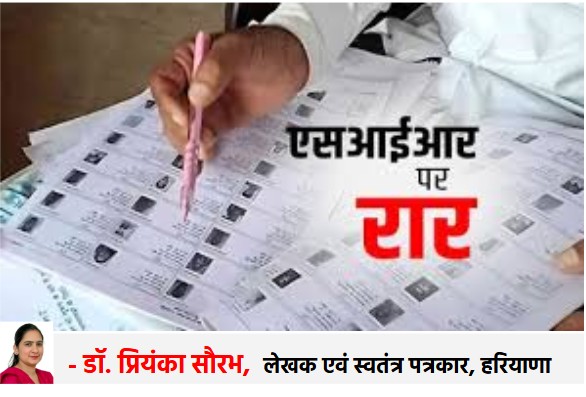
BhaIt is the largest democracy in the world, where the real power of governance is believed to lie in the hands of the people. Here the government is elected by the people and as per the clear provision of the Constitution, this process is governed by the impartial structure and working style of the Election Commission. The voter list is the cornerstone of this entire process—because it is through it that citizens exercise their franchise. Therefore, the credibility and purity of the voter list is extremely essential for the stability of democracy. This context makes the special intensive revision process—Special Intensive Revision (SIR)—so important. Errors in the voter list come in many forms—names of dead persons, names of one person appearing in two places, names of eligible voters missing, or non-correction despite change of address. Such a situation raises questions on the fairness of elections. Article 324 of the Indian Constitution gives the Election Commission wide-ranging powers, including the conduct, control, direction and supervision of elections. Therefore, SIR is not merely an administrative process but a constitutionally enshrined democratic obligation.
The Election Commission has been regularly amending the voter list since the Constitution came into force in 1950. In some states, during the SIR a large number of names of the deceased were removed, incorrect entries were rectified, and transferred or newly eligible voters were added to the list. The examples of revisions in Bihar and Bengal show that removing names that had been inactive for a long time made the voter list more genuine and transparent.
Nearly 47 lakh names were removed from the list of 7.6 crore voters in Bengal, which shows how distorted the list can be if there is no regular revision. Errors in voter rolls are not just a technical problem—they directly attack electoral fairness, the right to representation, and public trust. If a citizen’s name is missing from the list, he is deprived of his fundamental democratic right—the franchise. On the other hand, retaining the names of dead or transferred people increases the possibility of fraudulent voting or political misuse.
These discrepancies weaken the legitimacy of democracy. Some people tend to see SIR as political interference or interference in voter lists by the government, while this suspicion is unfounded. Purification of voter list is not necessary for the victory or defeat of any party, but for a fair election process. The Election Commission is a completely autonomous institution and its decisions are considered protected even by the courts.
The Supreme Court has clearly stated in several decisions that fair elections are the cornerstone of democracy and for this it is essential to ensure the purity of the voter list. Active participation of citizens is also important during SIR. The process slows down if people do not check their own entries, do not report errors to the relevant booth level officials, and do not provide documents. Even today, there are a large number of citizens whose names are incorrect and they do not come forward for correction.
This indifference weakens democracy. Therefore, the Election Commission has increased the use of digital tools—like Voter Helpline App, online forms, portals—so that people can easily make amendments. Those opposing SIR should understand that this process is to remove discrepancies in the voter list, prevent fraudulent voting and secure the true voter base. In states where the process was halted or stalled due to political controversy, massive errors were found in the voter lists.
In such cases, the courts themselves have issued guidelines reiterating the need for purification of voter lists. Therefore, opposition to SIR is opposition to democratic values. In a huge country like India with more than 96 crore voters, updating the voter list is a very complex, huge and ongoing process. It is not enough to consider it merely a government responsibility; This is also a civic duty. The Election Commission only provides the framework, but the responsibility of making it effective depends on the cooperation of the public.
Keeping your entry correct in the voter list is as important as voting on the polling day. Ultimately, democracy is not just a day of voting—it is the name of the entire system. To keep this system strong, the purity of the voter list is of paramount importance. SIR ensures that elections are fair, transparent and credible. It keeps the spirit of the democratic system alive and secures the rights of the citizens. Therefore, it is the duty of every responsible citizen to raise awareness about regular purification of voter lists, motivate citizens for participation and support processes like SIR.
Note: These are the personal views of the author
Read this also – Click to read the news of your state/city before the newspaper.
Web Title-The question of purity of voter list in democracy and the necessity of SIR