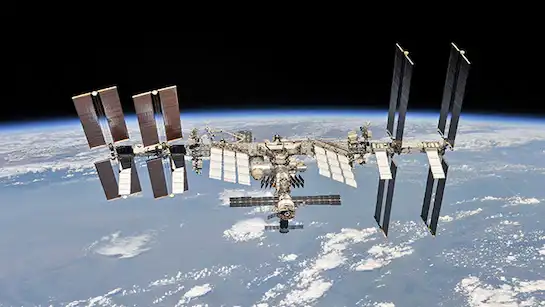
For more than 25 years, it has been protecting us like a shining diamond in the darkness of space. This is the most spectacular place ever created by humans, where astronauts see sunrise and sunset 16 times in a single day. Here, all national boundaries disappear, and scientists from different countries work together as a team, and make new discoveries for the betterment of humanity.
When will it be deorbited?
In 2030, NASA plans to deorbit a space station the size of a football field. It will be safely immersed in the Pacific Ocean. The space station will fall from the sky like a ball of fire and sink into the sea. Although its destruction may seem unfortunate, it is a necessary step to advance space science.
What is the reason for closing it?
The ISS was launched on November 20, 1998, when its first module, Zarya, was launched into space. Humans have been living there since 2000, and it has been in space for more than 25 years now. It was built by Russia, and funded by America (NASA). This provided the station’s initial power and propulsion.
effects of difficult circumstances
The space environment is very dangerous. Over the past 25 years, the station has endured the effects of extreme heat and cold, dangerous radiation, and small space debris. Like any machine, it also has a lifespan. Its parts are now showing signs of wear and tear, so it is not safe to keep it there any longer.
How will it be brought down?
This 400 ton station cannot be abandoned just like that. For this, NASA has entrusted SpaceX with the task of building a special spacecraft. This spacecraft will connect to the station and using its engines will slowly push it towards the Earth. A location in the ocean, known as Point Nemo, has been selected for deorbiting. This place is thousands of kilometers away from any human settlement or land.
What is a space graveyard?
This place is so far away that it is called the graveyard of spacecraft. As the station enters Earth’s atmosphere, it will become extremely hot due to air friction. This heat will burn most of the station, and the few pieces that remain will sink to the bottom of the ocean.