
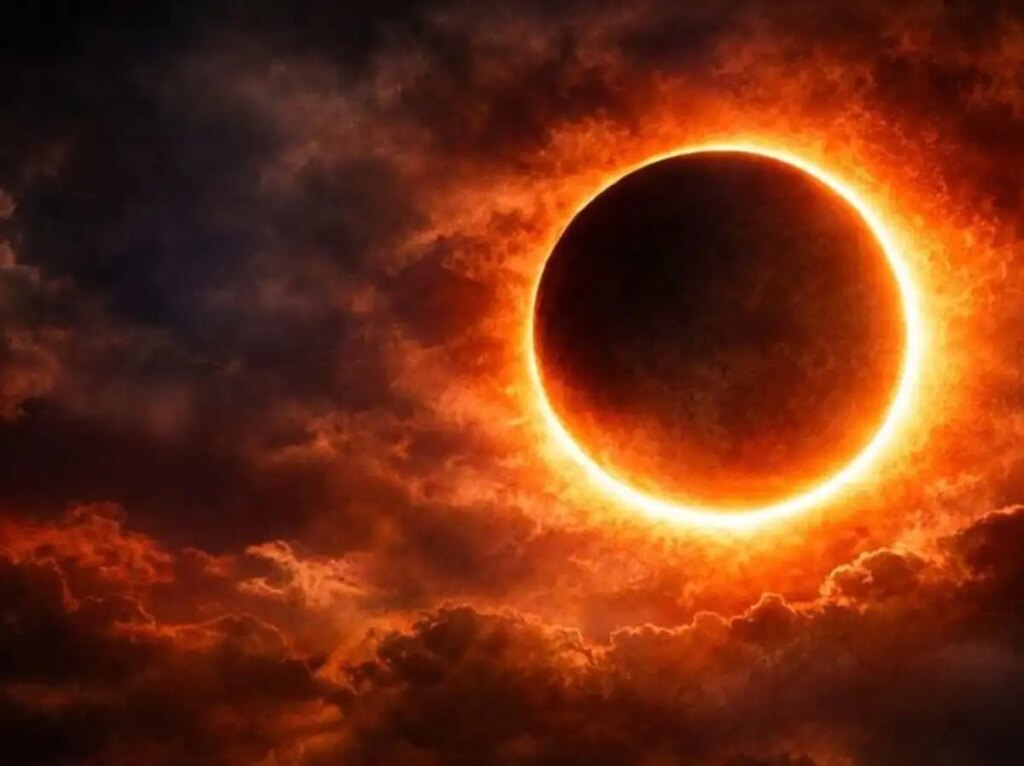
A total of four eclipses will occur in the year 2026. These will include two solar eclipses and two lunar eclipses. The first solar eclipse of 2026 will occur in February and a lunar eclipse will occur in March. The second solar and lunar eclipse will occur in August.
Coincidence of solar eclipse in Aquarius after 37 years
Astrologer Dr. Anish Vyas, Director of Pal Balaji Astrology Institute, Jaipur-Jodhpur, said that the first solar eclipse of 2026 will take place on February 17. This solar eclipse will occur in Dhanishtha Nakshatra in Aquarius. According to astrological calculations, this is the first solar eclipse in Aquarius after 37 years, when Rahu, Mercury, Venus and Moon will also be present along with the Sun during the eclipse. Earlier, during the solar eclipse on March 7, 1989, the planets were in a similar position. Now, when a solar eclipse occurs in the year 2026, all these planets will transit in Aquarius. The combination of Sun and Rahu in Aquarius will also be effective.
The first solar eclipse of the year will take place on 17 February. This will be an annular solar eclipse. Although this solar eclipse will not be visible in India, but it will be visible in Zimbabwe, South Africa, Zambia, Mozambique, Mauritius, Antarctica, Tanzania and South American countries. The second solar eclipse of the year will occur on August 12, 2026, on the Hariyali Amavasya (new moon) of the month of Shravan. Except India, it will be visible in North America, Africa, Europe, Arctic, Greenland, Iceland and Spain.
Solar eclipse will not be visible in India
The first solar eclipse of the year 2026 will take place on 17 February. This solar eclipse will not be visible in India. Therefore its Sutak period will not be valid. Solar eclipse will not be visible in India. Therefore, this eclipse will not be considered to have any religious or astrological impact in India. Therefore, the Sutak period of this eclipse will not be valid in India.
Time and duration of eclipse
The solar eclipse will start at 3:27 pm Indian Standard Time on February 17 and end at 6:06 pm. This eclipse will last for a total of 4 hours 31 minutes. However, this eclipse will not be visible in India, nor will its Sutak period be valid.
threat of natural disasters
Cases of natural disasters may increase due to solar eclipse. These include earthquakes, floods, tsunamis and plane crashes. However, the loss of life from natural disasters is likely to be less. There will be sad news from films and politics. Business will increase, diseases will reduce, employment opportunities will increase and income will increase. There is a possibility of a plane crash. Political instability will increase across the world, which means the political atmosphere will remain hot. Political allegations and counter-allegations will increase. There will be changes in the power structure. Tension will increase on borders across the world. There may be protests, violence, protests, strikes, bank scams, riots and arson.