
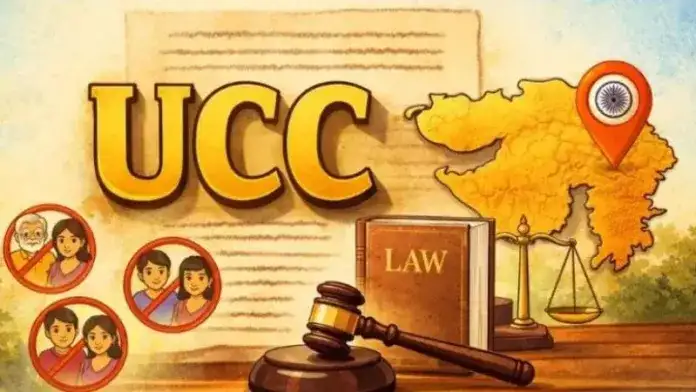
With the introduction of Uniform Civil Code (UCC) in Gujarat, the old rules related to marriage and property are about to become a thing of the past. By passing this bill with majority in the Assembly, Chief Minister Bhupendra Patel’s government has made it clear that from now on, law and not religion will be supreme in the state. This change has caused a stir among those who have already done more than one marriage or were thinking of doing so in the future.
Gujarat becomes the third state to implement UCC
After Uttarakhand, Gujarat has become the third state in the country to legalize the Uniform Civil Code Bill. There was a long debate on the issue in the Assembly on Tuesday night, however, the main opposition party, Congress, walked out of the House in protest. Despite this, the bill passed with a majority. Now in Gujarat, instead of religion-based laws, a single set of rules will govern matters like marriage, divorce, inheritance and live-in relationships. Since UCC has been in force in Goa since the Portuguese rule, Gujarat becomes the third state to enact such a law.
Will now two previous marriages be considered invalid?
People often wonder whether there will be any punishment for marriages that have already taken place—in particular, two marriages. According to legal experts, this law brings stringent provisions for future marriages. This means that, with immediate effect, no person can marry a second time while his/her first wife/husband is alive; However, the marriages of people who had married under their respective ‘personal laws’ before the implementation of this law will not be considered invalid. Still, those who do not register their marriage within the stipulated time—a mandatory condition under the new law—may face penalties. These punishments are for not registering, not for having two previous marriages.
Who will be exempted from this law?
Gujarat UCC 2026 will be applicable across the state, as well as to Gujaratis living outside the state borders. However, keeping in mind the interests of Scheduled Tribes (STs) and their distinct cultural heritage, the government has kept them out of the scope of this law. The Uniform Civil Code will not apply to communities whose traditional rights are protected under the Constitution. This ensures that while the law promotes uniformity on the one hand, it also respects diversity on the other.
End of practices like polygamy and halala
This new law of Gujarat completely bans polygamy (marrying more than one person). Furthermore, backward practices like Halala and Iddat will no longer be given any legal recognition within the state. Anyone found violating these rules can face both heavy fines and imprisonment. Registration of marriages is now mandatory rather than optional, with the aim of maintaining legal transparency in society and protecting women’s rights.