
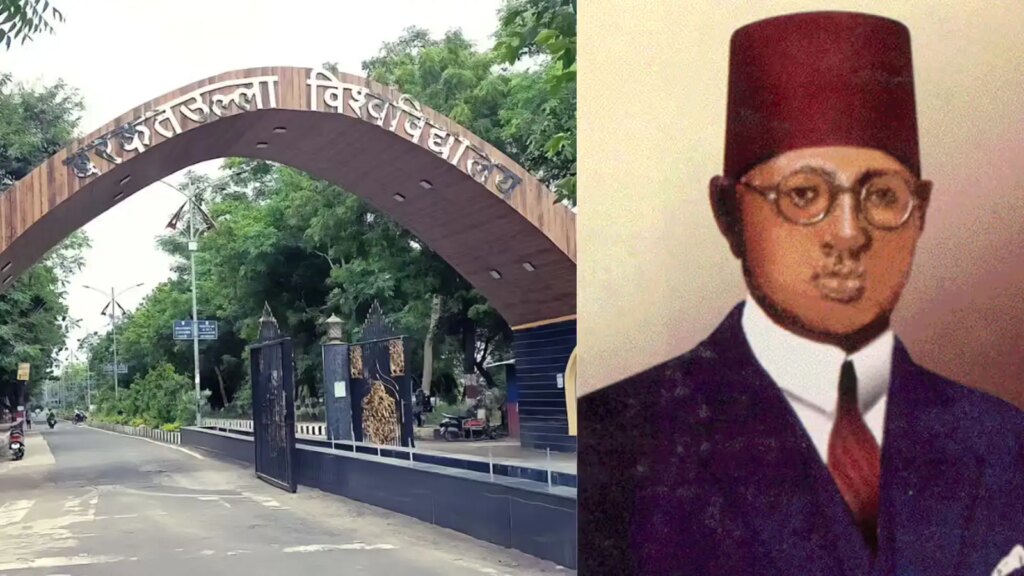
Amid the controversy over the proposal to rename Bhopal’s Barkatullah University as ‘Vagdevi Bhojpal University’, many people are digging into history to know about Barkatullah Bhopali – after whom the university currently stands. Bhopal University, established in 1970, was renamed ‘Barkatullah University’ in 1988. The Executive Council of the University has approved the proposal to change the name of the institution to ‘Vagdevi Bhojpal University’. Now this proposal has been sent to the Governor (who is also the Chancellor of the University) for final approval. It is natural that both supporting and opposing voices are being raised on this discussion of changing the name. Those who are opposing the move consider it ingratitude and an insult to the memory of the great freedom fighter Barkatullah Bhopali. Who was Barkatullah Bhopali? Read his story here.
India’s freedom struggle was fought in foreign countries also
The fight for independence against British colonial rule was fought not only in the country but also abroad. Indians who went abroad for education or other reasons also felt the pain of slavery like their countrymen. Barkatullah Bhopali was one such person. Born in 1862 in Bhopal, Barkatullah received his early education there. The wounds of the failed revolution of 1857 were still fresh, yet public anger against the British remained. Among the new generation were many young people who believed that education – and especially learning the English language – was essential to the future fight against the British.
Inspired by this motive, Barkatullah first took admission in Wilson College, Bombay. Soon he became famous there due to his patriotic activities. Meanwhile, the famous Islamic scholar Maulana Riazuddin Dehlvi was preparing to go to London. Recognizing Barkatullah’s ability, he took this young man with him. While studying there, Barkatullah continued to write and speak about Britain’s economic exploitation of India and the plight of its common people, and continued to express his anger against British rule.
eviction from london
Barkatullah soon came under the radar of police and intelligence agencies due to his anti-British articles and passionate speeches. Warnings to ban them had no effect; After this, he was ordered to leave Britain. Instead of returning to India, Barkatullah went to America. He came into contact with Alexander Russell Webb and started campaigning for independence there too. He wrote several articles for the American magazine *The Friend*, in which the looting of India by the British administration and the atrocities on its people were exposed.
On the advice of Maulana Mahmood Hasan, he went to Japan and was appointed Professor of Urdu at Tokyo University. However, even there he never forgot his main goal – India’s independence. To raise his voice in favor of India, he started a newspaper named *Islamic Fraternity*, which was published in both Japanese and English languages. His articles published in newspapers and other magazines helped spread awareness among the people of Japan, China, Indonesia and Malaya (Malaysia) and united them in support of India’s independence.
One of the founders of Gadar Party
Due to his command over several languages, including Urdu, Arabic, Persian and English, his anti-British writings had a wide reach and influence. This was not limited to his writing only; As an influential speaker, his speeches left a deep impression in all the countries he visited, including India, England, Japan, America, Germany, Turkey and Afghanistan. These efforts were not made alone. Before the First World War, Barkatullah, along with Lala Hardayal and Krishnaji Verma, founded the ‘Indian Association of the Pacific Coast’ in California. This organization later became famous by the name of Ghadar Party, whose objective was to overthrow the British rule in India. To expand the party, Barkatullah Bhopali, along with Parmanand and Lala Hardayal, made an extensive tour of America and Canada, spreading awareness among thousands of Indians living there and motivating them to come forward for the country’s independence.
After the party was banned in America and Lala Hardayal was arrested, Barkatullah moved to Germany via Turkey to carry forward the movement. There he met revolutionary king Mahendra Pratap. Champak Raman Pillai, Veerendranath Chattopadhyay, Dr. Prabhakar, Dr. Hafeez, Trimul Acharya, Dr. A. A group of freedom fighters including Mussoorie, Khari Naam Parsi, Dr. Tarak Nath Das, Chandra Kumar Chakraborty and Harendra Nath Gupta had gathered there and were working to determine the direction of the struggle.
Government-in-Exile formed in Kabul
This exile government, formed in Kabul, the capital of Afghanistan on 1 December 1915, played an important role in India’s freedom struggle. The Prime Minister of this government formed under the leadership of Raja Mahendra Pratap Singh was Barkatullah Bhopali. The objective of this government was to achieve India’s independence by gathering international support against British rule.
The First World War began in 1914. Britain’s enemies – especially Germany and Türkiye – were trying to weaken British rule in India. To take advantage of this opportunity, Indian revolutionaries active abroad made a big plan. The Berlin Committee and other revolutionary organizations working in Germany tried to incite rebellion in India by using Afghanistan as their base. This government called itself the real government of independent India and declared British rule illegal.
India’s first claim of sovereignty on foreign soil
The government-in-exile made large-scale diplomatic efforts to garner international support against Britain. Its goals included convincing the Afghan emir to wage war against Britain and gaining the support of Germany, Turkey, Russia, China, and Japan. One of its objectives was to instigate armed revolution in India. As a result, the government could not get formal recognition. Due to increasing British pressure, Raja Mahendra Pratap, Barkatullah Bhopali and others had to leave Kabul. Although this government could not actually liberate India, its importance is immense; It was the first national government-in-exile of India. This was the first government that claimed India’s sovereignty over foreign soil. This government served as inspiration for the Azad Hind government formed by Subhash Chandra Bose in 1943. It also dealt a huge blow to England’s international credibility.
persevere despite poor health
The activities of the government-in-exile continued until 1920. After facing disappointment in Afghanistan, Barkatullah visited Russia. He had a fruitful meeting with Lenin and received assurances of help, although the initiative did not go ahead. The next destination was Berlin. Meanwhile, Barkatullah continued writing for newspapers and delivering speeches at various meetings, opposing British rule and advocating India’s independence. During a conference in Switzerland, he met Pandit Jawaharlal Nehru, Hakim Ajmal Khan and Dr. Mukhtar Ahmed Ansari. They discussed in detail ways to further intensify the struggle.
Pandit Nehru advised Barkatullah to return to India. However, he said that he would set foot in his motherland only when it was freed from the shackles of British slavery. But, this could not happen during his lifetime. He was battling illness. His comrades in the Gadar Party kept raising money for his treatment. Even in these circumstances he was not ready to stop or rest. He died on September 27, 1927, while struggling to realize the dream of independence.