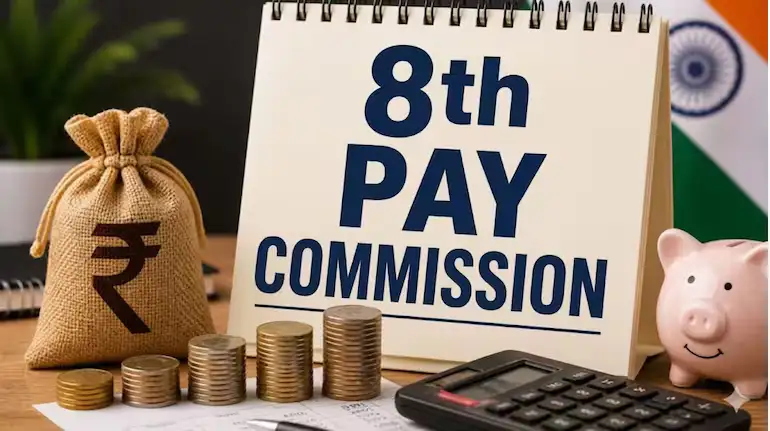
Important developments related to the 8th Pay Commission have begun for millions of central government employees and pensioners across the country. The Commission is continuously holding meetings with different employee organizations and unions in different parts of the country to discuss the revision of pay, pension and allowances. Demands related to ‘fitment factor’ are being raised at various levels, raising expectations of a huge increase in the minimum basic pay. Let us see when the 8th Pay Commission report is expected, when will employees start receiving their revised salaries and how the arrears will be calculated.
When will the recommendations of the 8th Pay Commission be implemented? Know the possible deadlines
After releasing the ‘Terms of Reference’ (ToR) in November 2025, the 8th Pay Commission has been given 18 months to submit its report. Experts estimate that after the submission of the report, the government may take an additional 3 to 6 months to implement its recommendations. As a result, there is a strong possibility that the new salary structure and allowances will be implemented in the second half of 2027.
When will the dues be paid?
Although the Pay Commission has not yet officially announced the effective date of the arrears, an analysis of the pattern established by previous pay commissions shows that the new rules are generally considered to be effective from the day following the end of the previous commission. Since the 7th Pay Commission was completed on December 31, 2025, it is expected that the central government employees will start getting the benefits of revised pay and arrears from January 1, 2026. This means that whenever the new pay scale is finally implemented, the employees will get the full arrears (remaining dues) for the entire period from January 2026 till the date of implementation.
Demand to increase minimum basic salary to ₹69,000
Various organizations have put forward several proposals regarding ‘fitment factor’ as part of the pay and pension reform process. The National Council-JCM has demanded increase in fitment factor of 3.833 and minimum basic pay to ₹69,000. The All India Defense Employees Federation (AIDEF) has also advocated a fitment factor of 3.83. If the government accepts these demands – even partially – it will result in a record increase in the salaries of employees.
A unique formula of Railway Employees Organization:
The Indian Railway Technical Supervisors Association (IRTSA) has presented a new and unique proposal before the Pay Commission, demanding five different fitment factors for different levels of employees. Under this formula, a multiplier of 2.92 has been proposed for employees at Level 2 to Level 5, while a multiplier of up to 4.38 has been proposed for top executives at Level 17 and 18.
A round of meetings continues at the national level:
The 8th Pay Commission is currently visiting different cities across the country, and is talking to all concerned parties and hearing their demands. Recently, central institutions, unions and organizations were invited to Lucknow, Uttar Pradesh to present their demands. Earlier, similar meetings were successfully held in Pune, Dehradun and New Delhi; Further, an important discussion has also been planned between the Commission and the employee organizations of Jammu and Kashmir and Ladakh in June 2026.