
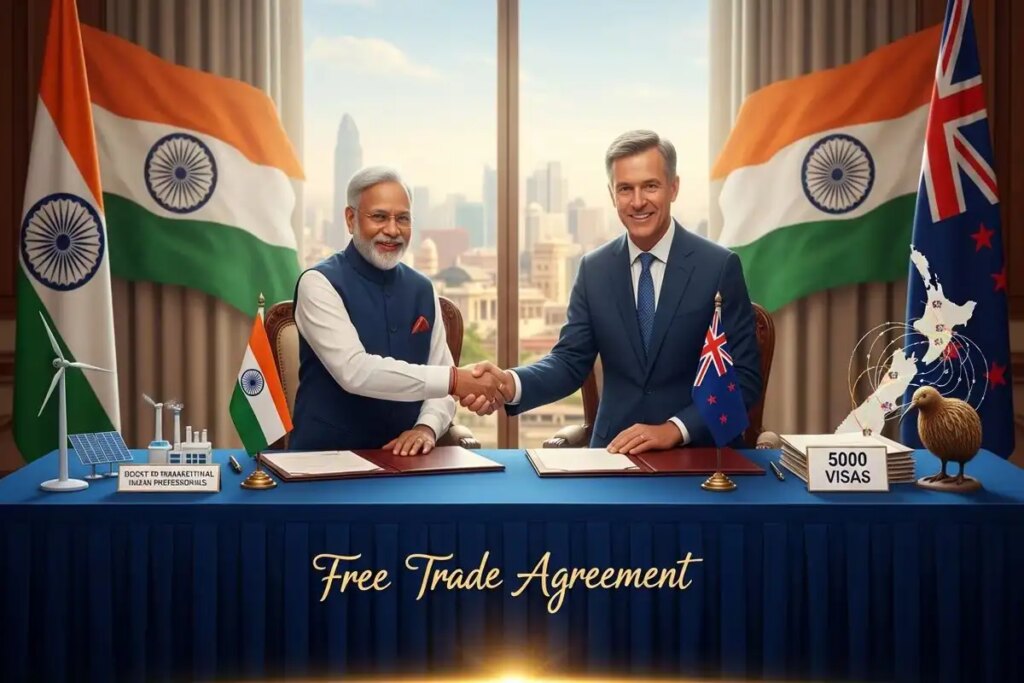
India and New Zealand today ushered in a new era of trade relations by signing a historic Free Trade Agreement (FTA). In this era of global uncertainty, both the countries have given a strong message to the world by completing this agreement within a record-breaking nine months. Commerce Minister Piyush Goyal and New Zealand’s Trade and Investment Minister, Todd McClay finalized the “once in a generation” agreement by exchanging relevant documents. Speaking during a joint statement and using cricketing terminology, Commerce Minister Piyush Goyal commented, “Today, the Indian Ocean feels a little smaller, and the bond between our two great democracies feels even stronger. We meet at a time when the world is choosing new partners, and in this changing world, India and New Zealand have chosen each other.”
Both countries described this deal as a milestone
This agreement is not merely a commercial document; Rather, it is a gateway to a deep, people-centric and enduring partnership between India—the world’s fastest growing major economy—and New Zealand, a developed nation in the Pacific region. Both countries have described the deal as a “milestone”. The primary objective of this agreement is to double bilateral trade over the next five years, aiming to achieve a total value of $5 billion. Additionally, it also aims to attract investments of $20 billion over the next 15 years.
A new blueprint for trade and investment
Under the terms of the agreement, New Zealand will provide Indian companies with completely duty-free access to its markets. Currently, many products exported from India attract a duty of up to 10%, which will now be reduced to zero. In return, India will implement significant duty reductions or exemptions on approximately 95% of products imported from New Zealand. This includes commodities such as wool, wood, seafood, and certain fruits (such as avocados and cherries).
Benefits of India-New Zealand Free Trade Deal
**Substantial Investment:** New Zealand to invest $20 billion in India’s manufacturing and infrastructure sectors over the next 15 years.
**Duty-free access:** Indian products—such as textiles, leather goods, carpets and automotive parts—will get duty-free entry into New Zealand.
**Visa and Employment:** Every year, 5,000 Indian professionals (including those teaching IT, engineering, AYUSH and yoga) will be granted a 3-year employment visa.
**Opportunities for Students:** Under the ‘Working Holiday Visa’ scheme, 1,000 young Indians will be able to travel to New Zealand and work there for a year.
**Agriculture and Technology:** Cooperation will be increased in respect of products like kiwi, apple and honey under the ‘Special Agro-Technology Action Plan’.
What is going to be cheaper in India?
1. Fruits and dry fruits
New Zealand is famous for its high quality fruits. Under this agreement, special concessions have been granted for:
**Kiwi Fruit:** Quota-based tariff on Kiwi has been significantly reduced. Up to a certain quantity, these fruits can now be imported into India without any additional tax.
**Apples:** Provisions have been made to reduce the tax on New Zealand apples by 50%.
**Berries and other fruits:** Premium fruits like avocado, blueberries, cherries and persimmons will now be available at lower prices.
2. Wine and Spirits
New Zealand’s wine is famous all over the world. Till now, India imposed heavy duty of up to 150% on these products; Now this duty will be reduced to the range of 25% to 50% (depending on the price of the wine). As a result, high quality New Zealand wines will become significantly cheaper in India.
3. Seafood
If you are fond of seafood, then there is good news for you.
Taxes on seafood products—such as salmon and mussels—imported from New Zealand are being reduced or eliminated altogether. 4. Wool and wood
Sheep meat and wool: Duty on sheep meat and wool imported from New Zealand has been removed with immediate effect. This can make winter woolen clothes and blankets more affordable.
Timber: Up to 95% of tariffs on New Zealand timber and forestry products used in construction and furniture have been removed. 5. Other special products
Manuka Honey: This precious honey, known for its medicinal properties, will now become more affordable due to the reduction in tariff.
Infant Formula: Concessions have also been made on products such as bulk infant formula and milk albumin.
Security of sensitive areas: Farmers’ interests paramount
India has wisely protected its domestic interests under this agreement. To ensure that Indian farmers and local industries do not suffer any loss, dairy products (milk, cheese, curd), onions, sugar, spices, edible oils and rubber have been completely kept out of the scope of tariff concessions. In other words, New Zealand dairy products will not be able to enter the Indian market without any tariffs.
New Zealand’s Trade and Investment Minister, Todd McClay, says India is a strategic priority for New Zealand. For our exporters, this is a “once in a generation” opportunity to invest in a market of 1.4 billion people. I urge our businesses to actively explore joint ventures and investment opportunities in India.
revolution in professional mobility
For the first time in its relations with any country, New Zealand has a special arrangement regarding student mobility and post-study work visas. This simplified visa process will not only benefit IT and healthcare professionals, but will also open new avenues for chefs, music teachers and traditional healers to pursue their careers on foreign soil.
Amid global uncertainties and supply chain challenges, the India-New Zealand FTA is being considered an important “milestone”. This agreement could prove to be a decisive vehicle in establishing India as a trusted hub within global supply chains and connecting New Zealand investors to India’s growth story.