
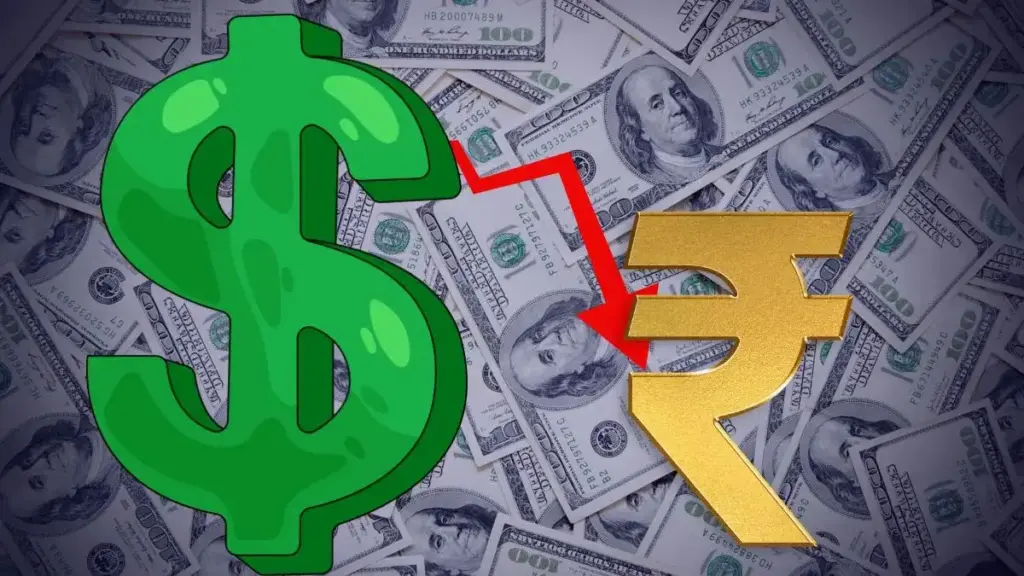
The Indian Rupee continues to fall, reaching a new all-time low and hitting 92 against the US Dollar. This sharp decline in the Indian currency has come at a time when global uncertainty is high and foreign capital inflows into emerging markets have slowed significantly. The rupee has weakened by 2.3% in January 2026 alone. Weakening of currency is not considered good for any country and it has many negative side effects.
Continuous decline in rupee
If we look at the performance of the Indian Rupee, it has been continuously weakening against the Dollar for a long time. It opened at 91.9125 on Friday, almost equal to the previous trading day’s closing price of 91.9550. In the last session, the Indian currency had fallen to an all-time low of 91.9850. The Indian rupee has slipped nearly 2.3% so far this month, its worst monthly performance since September 2022.
Main reasons for fall in rupee
Talking about the main reasons for the continuous weakness of the rupee, this decline in the Indian currency has come at a time when global uncertainty is already at its peak due to factors like tariffs and trade war. This has reduced the inflow of foreign capital into emerging markets. Meanwhile, higher interest rates in developed economies have pushed up returns on foreign investments, making investors more cautious about their investments. It is also worth noting that India has a current account deficit. This simply means that there is dependence on foreign capital to bridge the gap between imports and exports. When these cash flows weaken, pressure on the currency increases, and it begins to weaken.
Discussion on rupee also in economic survey
Speaking at a press briefing after the Economic Survey 2026 was presented in Parliament on Thursday, Chief Economic Adviser (CEA) V. Ananth Nageswaran repeatedly stressed the importance of understanding the weakening of the rupee. He said that the decline in currency that we are seeing today is not limited to India only. According to CEA, countries with current account deficits have also experienced currency devaluation. However, he said the long-term performance of the rupee has been relatively stable. If you look at the performance of currencies of different countries since the beginning of this millennium, the Indian Rupee has actually been performing quite well. He explained that when foreign cash flows slow down due to global reasons, the currency of the countries where capital is imported automatically weakens.
How will the rupee improve?
The Chief Economic Advisor further clarified that permanent strengthening of the currency cannot be achieved through intervention alone. He emphasized that manufacturing capacity is the first condition for currency stability and strength. According to Nageswaran, strong growth in manufacturing exports improves the current account position and provides support to foreign exchange reserves, which gradually increases confidence in the country’s currency. Giving examples, he said that if you look at stable currency countries like Switzerland, Japan, Korea, Taiwan and Singapore, all these countries have a good presence in the manufacturing sector.
What are the disadvantages of weakening rupee?
According to CEA, the Indian rupee reaching its lowest ever level cannot be considered an immediate sign of economic crisis. However, this reflects weakness in global capital flows and investor caution, which India cannot ignore. Regarding the problems caused by currency weakening, the risk of inflation increases due to continuous weakening of the rupee against the dollar.
Its impact is felt in many sectors, from petroleum products to students studying abroad. To understand this, consider that India is one of the largest importers of crude oil, importing 80% of its requirement. When the rupee weakens, India has to spend more dollars, which increases the risk of petrol and diesel prices rising. This increases the cost of transportation and logistics, which can increase inflation. In short, a weak rupee makes imported goods costlier, and sending money abroad also becomes costlier.